The first time I applied for a municipal akiya subsidy, I expected a simple form and a quick answer. Instead it took 11 weeks, three site inspections, and a stack of receipts before I saw a single yen of the promised 800,000 yen renovation grant. That experience taught me the single most important lesson about these programs: the rules are set town by town, not nationally, and two properties 40 kilometers apart can qualify for completely different amounts of help.
Across my 9 properties, I’ve now worked with subsidy offices in four different municipalities, and the variation still surprises me. Some towns are desperate to fill vacant houses and will hand over cash within a month. Others treat every application like a tax audit. Here’s what I’ve learned about navigating that patchwork.
Why subsidies differ so much between municipalities
ud83duded2 RECOMMENDED PRODUCTS
Japan Real Estate Investment Guides
Understand the market before you enter it u2014 these books accelerate your learning curve.
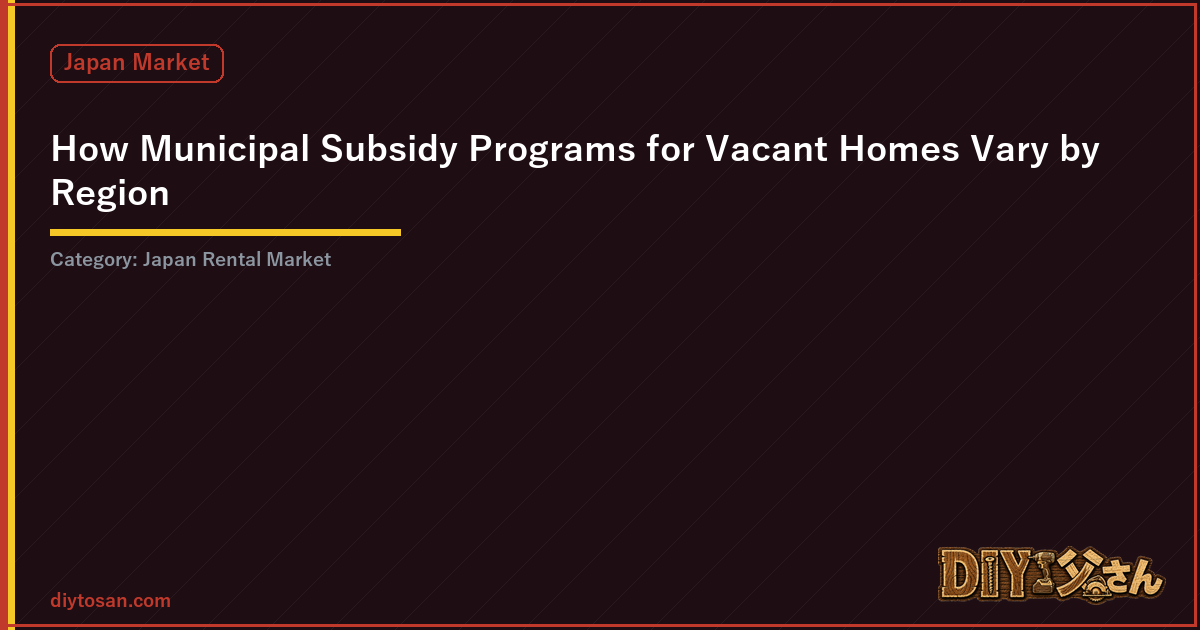
Japan’s vacant home problem is handled locally because the akiya crisis hits some regions far harder than others. A rural town losing 3% of its population every year has a real incentive to pay you to move in and fix up a house. A suburban ward with a tight housing market has almost no incentive at all. I’ve seen renovation subsidies range from as low as 200,000 yen in built-up areas to as high as 1.5 million yen in depopulating mountain towns, and the application complexity tends to scale in the opposite direction of the money on offer.
Renovation grants versus demolition grants
ud83duded2 RECOMMENDED ON AMAZON US
Japanese Language Textbooks (N3 Level)
Reading contracts in Japanese removes your dependence on agents and translators.
Most municipalities split their programs into two buckets, and it’s worth knowing which one you’re actually applying for.
- Renovation subsidies (kaishu hojokin): typically cover 30-50% of construction costs up to a set ceiling, often between 500,000 and 1 million yen
- Demolition subsidies (kaitai hojokin): usually cover a flat percentage, around 20-40%, of teardown costs, sometimes capped near 500,000 yen
- Relocation or settlement incentives: a smaller number of towns add a lump sum, commonly 300,000 to 500,000 yen, if you commit to living in the property for 5 years or more
- Combination packages: a handful of municipalities let you stack renovation and settlement money, which is where the real value is
I renovated one property with a combined package that returned about 1.1 million yen against roughly 3.4 million yen in total costs, a 32% reduction I would never have gotten in a municipality without a stacking option.
The paperwork nobody warns you about
Every subsidy office I’ve dealt with wants proof before, during, and after the work. That means dated photographs of the akiya taken before demolition or renovation begins, itemized quotes from a licensed contractor, and a final inspection once the work is done. Miss the pre-work photo requirement and you can lose eligibility entirely, no exceptions, even if the renovation itself is perfect. I now photograph every wall, floor, and fixture in a vacant property the moment I get the keys, purely so I have proof on hand no matter which town’s program I end up using.
Timing windows and annual budgets
ud83duded2 RECOMMENDED PRODUCTS
Due Diligence Checklists & Guides
Never skip due diligence. These tools help you ask the right questions.
This is the part that trips up most landlords. Municipal subsidy budgets are set once a year, often in April, and once the allocated funds are spent, that’s it until the next fiscal year. I’ve had an application rejected in January simply because the town had already distributed its entire 8 million yen annual subsidy pool to earlier applicants. If you’re serious about using one of these programs, call the town hall’s akiya desk in March or April to ask when the new budget opens, and submit your application within the first month if you can.
Residency and registration requirements
Almost every program requires the applicant to register a juminhyo (resident registration) in that municipality, either before or shortly after the subsidy is approved. A few towns extend this to rental use, but many restrict subsidies to owner-occupiers only, which caught me off guard on my third property. Before assuming a subsidy applies to a rental unit, ask the office directly whether investment or rental properties qualify, because the printed brochure often doesn’t spell this out clearly.
How I evaluate a new area before buying
Before I make an offer on a vacant property now, I call the local akiya consultation desk and ask three questions: what percentage of renovation cost is covered, whether rental properties are eligible, and how much budget remains for the current fiscal year. That 15-minute phone call has saved me from at least two purchases where I assumed subsidy money would be available and it simply wasn’t. It also occasionally uncovers programs that aren’t listed on the akiya bank website at all, since some towns only tell you about the better incentives when you ask in person.
I also keep a simple spreadsheet comparing every municipality I’ve worked with, listing the subsidy ceiling, the coverage percentage, whether rentals qualify, and the typical processing time. After four towns and roughly 20 individual applications over the years, the pattern is clear: the towns offering the largest grants, sometimes over 1 million yen, are almost always the ones losing population fastest, and they tend to move quickest once your paperwork is in order because they genuinely want the property occupied. Towns with smaller subsidies, closer to 300,000 yen, often take longer simply because akiya applications are a low priority compared to their other administrative work.
What I’d tell a landlord applying for the first time
If you’re new to this, don’t rely on a single conversation or a single web page. Call twice, a few weeks apart, and confirm the same details both times, because I’ve had staff give me conflicting numbers on coverage percentage depending on who answered the phone. Keep every receipt from day one, even for small purchases like screws or paint, since some municipalities will deny reimbursement for a 400,000 yen renovation over a missing 3,000 yen receipt. And build your renovation budget assuming the subsidy might arrive 2 to 3 months later than promised, because cash flow timing has caused me more stress than the paperwork itself ever has.
That’s the approach I use across all 9 of my properties: never assume the subsidy rules from one town apply to the next, and always get the fiscal year budget confirmed before you commit to any purchase.
Complete Roadmap: First Rental Property in Japan
Everything I wish I knew before my first purchase u2014 financing, due diligence, negotiation, and year-one management guide.
ud83cudfe0 More from DIY Father
15 years of landlord experience u00b7 3 apartment buildings u00b7 DIY renovations that saved millions of yen. Browse all articles at diytosan.com