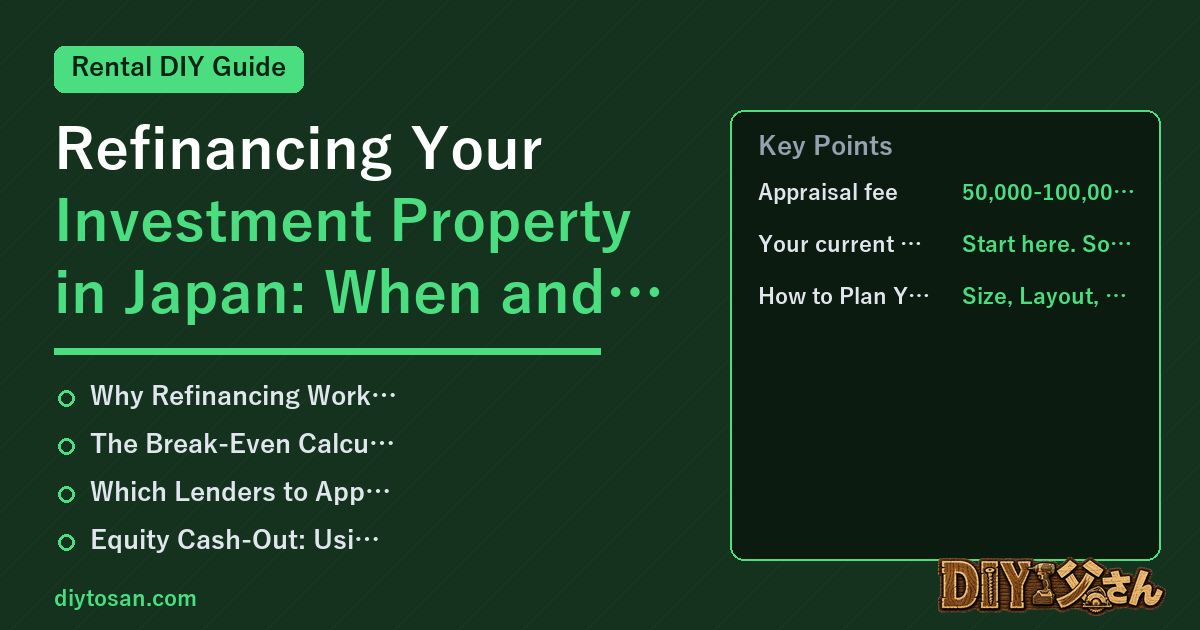
Refinancing Your Investment Property in Japan: When and How
Three years into owning my first rental property, I refinanced and cut my interest rate from 2.8% to 1.9%. That single move added roughly 85,000 yen to my annual cash flow without changing anything about the property itself. Refinancing is a tool that Japanese landlords don’t discuss often enough. Let me explain when it makes sense and how to execute it.
Why Refinancing Works in Japan’s Current Rate Environment
ud83duded2 RECOMMENDED ON AMAZON US
Real Estate Investment Books
The books that changed how I think about money, leverage, and long-term wealth.
Japan has maintained extremely low interest rates for decades, but there’s still meaningful variation between lenders and loan products. The gap between a new borrower’s rate today versus a loan originated five years ago can be 0.5 to 1.5 percentage points. On a 20 million yen loan, that difference equals 100,000-300,000 yen in annual interest savings.
Additionally, your credit profile may have improved since your original loan. If you’ve paid reliably for several years, have lower overall debt, or have seen your income grow, you may qualify for better terms than you did originally.
The most common refinancing motivations I see among fellow landlords:
- Interest rate reduction (u6700u3082u4e00u822cu7684)
- Extending the loan term to improve monthly cash flow
- Consolidating multiple properties under a single lender
- Pulling out equity (cash-out refinancing) to fund additional investments
The Break-Even Calculation: Is Refinancing Worth It?
ud83duded2 RECOMMENDED ON AMAZON US
Financial Calculators for Investors
Run yield and cash-flow calculations in seconds u2014 worth every yen on your first deal.
Refinancing isn’t free. In Japan, you’ll typically pay:
- Loan origination fee (u878du8cc7u624bu6570u6599): Often 1-2% of the new loan amount, or a flat fee of 50,000-100,000 yen
- Prepayment penalty on the old loan (u7e70u4e0au8fd4u6e08u624bu6570u6599): Fixed-rate loans often charge 1-3 months of interest. Variable-rate loans sometimes have no penalty.
- Registration fees for changing the mortgage (u62b5u5f53u6a29u5909u66f4): Approximately 20,000-40,000 yen in government fees plus judicial scrivener costs
- Appraisal fee: 50,000-100,000 yen if the new lender requires a property appraisal
Total refinancing costs typically run 300,000-800,000 yen for a mid-size investment property loan.
Break-even formula: Total refinancing cost u00f7 Monthly savings = Break-even months
My example: Refinancing costs were 420,000 yen. Monthly interest savings were 7,100 yen (85,000 yen u00f7 12). Break-even: 420,000 u00f7 7,100 = 59 months (about 5 years). Since I planned to hold the property for at least 15 more years, it made clear financial sense.
Which Lenders to Approach and What They Want
For investment property refinancing in Japan, you have several options:
- Your current lender: Start here. Sometimes they’ll negotiate a rate reduction just to keep your business, without all the paperwork of a full refinance.
- Regional banks (u5730u65b9u9280u884c): Often more flexible with investment property financing than major city banks. They understand local market conditions and may be more willing to lend on older properties.
- Shinkin banks (u4fe1u7528u91d1u5eab): Credit unions that focus on local businesses and residents. Often the best option for smaller investors and older properties.
- Online lenders and mortgage specialists: SBI, ARUHI, and similar non-bank lenders offer competitive rates but may have stricter property condition requirements.
What lenders evaluate for refinancing is similar to original financing: your income, credit history, debt load, and the property’s current condition and cash flow. Have your rent roll, income tax returns for the past 2-3 years, and current lease agreements ready to submit.
Equity Cash-Out: Using Your Property’s Value to Fund Growth
ud83duded2 RECOMMENDED PRODUCTS
Investment Analysis Templates
Spreadsheet analysis is the difference between a good deal and a disaster.
After five years of loan payments on my first property, I had built up meaningful equityu2014both through paydown and slight property appreciation. When I was ready to buy my third property, I refinanced Property #1 with a larger loan than the remaining balance, pulling out 3 million yen in cash to use as a down payment on the new purchase.
This is called cash-out refinancing (u62c5u4fddu8a55u4fa1u3092u4f7fu3063u305fu8cc7u91d1u8abfu9054), and it’s a legitimate and powerful portfolio-building tool. The key risks to understand:
- You’re increasing leverage on Property #1u2014your monthly payment goes up
- If the market drops, you could end up with negative equity
- The additional loan interest is tax-deductible, which partially offsets the cost
I only use cash-out refinancing when the new property I’m acquiring has a strong enough yield to comfortably service the increased debt on the original property. Never stretch yourself so thin that one vacancy across your portfolio creates a cash flow crisis.
Property Cash Flow Calculator + Complete Guide
The exact Excel spreadsheet I use for every property purchase decision u2014 5-year projection, yield calculation, and break-even analysis included.
ud83cudfe0 More from DIY Father
15 years of landlord experience u00b7 3 apartment buildings u00b7 DIY renovations that saved millions of yen. Browse all articles at diytosan.com