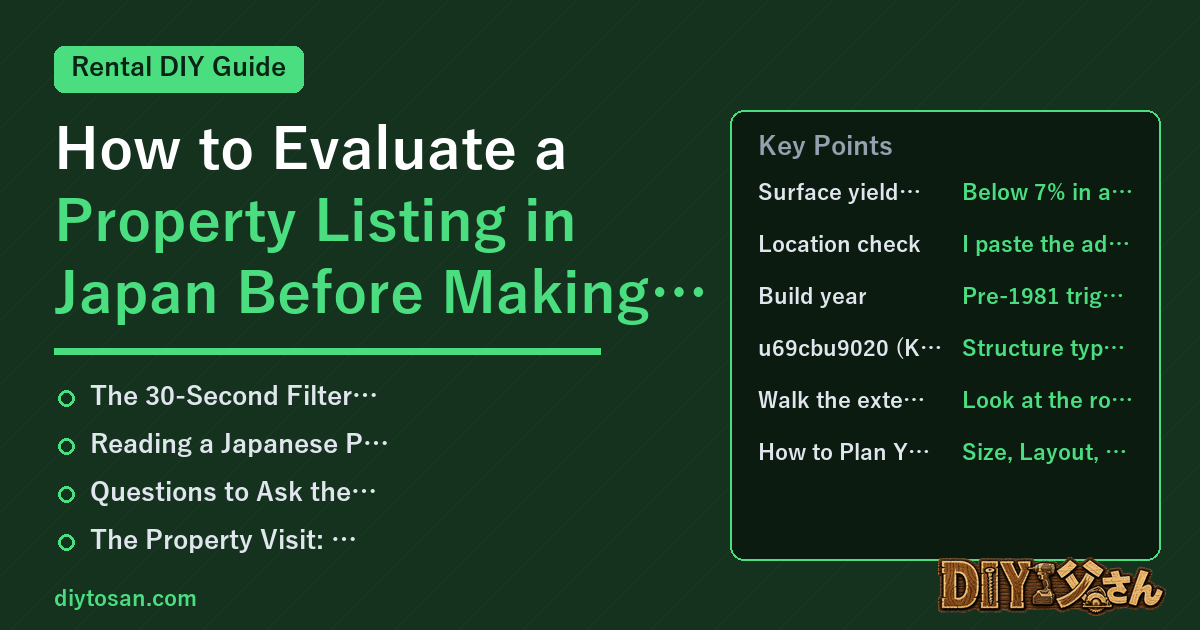
How to Evaluate a Property Listing in Japan Before Making an Offer
I’ve reviewed hundreds of property listings over the years and made offers on maybe a dozen. Most listings have something that makes them unsuitableu2014wrong yield, wrong location, hidden problems, or inflated price. Learning to quickly filter listings and deeply evaluate the promising ones is a core investment skill. Here’s my systematic approach.
The 30-Second Filter: What to Check First
ud83duded2 RECOMMENDED ON AMAZON US
Real Estate Investment Books
The books that changed how I think about money, leverage, and long-term wealth.
I use three quick filters to eliminate listings before spending real time on them:
- Surface yield threshold: Below 7% in a regional city? Skip it unless there’s something unusual about the location or situation.
- Location check: I paste the address into Google Maps and check: How far to the nearest station? Is this an area I’d feel comfortable visiting? Is there any commercial life nearby?
- Build year: Pre-1981 triggers a seismic check requirement. Not an automatic pass, but it means more work if I proceed.
These three filters take about 2 minutes and eliminate 80% of listings. The remaining 20% get a detailed review.
Reading a Japanese Property Listing: What the Numbers Mean
ud83duded2 RECOMMENDED ON AMAZON US
Financial Calculators for Investors
Run yield and cash-flow calculations in seconds u2014 worth every yen on your first deal.
Japanese property listings (u7269u4ef6u60c5u5831) for investment properties typically include:
- u7269u4ef6u4fa1u683c (Bussan Kakaku): Asking price. Always negotiable, especially if the property has been listed for more than 3 months.
- u8868u9762u5229u56deu308a (Hyomen Rimawari): Surface yield. Remember, this assumes 100% occupancy and zero expenses.
- u6e80u5ba4u60f3u5b9au5e74u53ce (Manshitsu Sote Nenshu): Annual income assuming full occupancy. The listing may show “u6e80u5ba4” (full) or “u73feu6cc1” (current condition) rent rolls.
- u5efau7269u9762u7a4d / u571fu5730u9762u7a4d: Building area and land area. Understand what you’re getting.
- u7528u9014u5730u57df (Yoto Chiiki): Zoning designation. This determines what can be built on the land and affects future redevelopment potential.
- u7bc9u5e74u6570 (Chikunensuu): Age of building.
- u69cbu9020 (Kozo): Structure type (u6728u9020, RC, etc.)
Questions to Ask the Listing Agent
Once a listing passes my quick filter, I contact the listing agent with a set of standard questions before visiting:
- What is the current occupancy rate, and how long have any vacant units been vacant?
- Can I see copies of all current lease agreements?
- What are the actual rents being paid by each tenant (versus the listed potential rents)?
- Has there been any history of problem tenants, non-payment, or legal disputes?
- What major repairs or capital expenditures have been done in the last 5 years?
- Are there any pending issues (leak repairs, equipment replacement) the buyer should know about?
- Why is the seller selling? (This is crucial information. Sudden sale by a motivated seller often means there’s a problem you haven’t found yetu2014or there’s genuine opportunity to negotiate.)
- Has the property had a recent seismic assessment?
The agent’s answersu2014and how quickly and completely they answeru2014tell me a lot about both the property and the professionalism of the seller.
The Property Visit: My On-Site Checklist
ud83duded2 RECOMMENDED PRODUCTS
Investment Analysis Templates
Spreadsheet analysis is the difference between a good deal and a disaster.
I never make an offer without visiting in person. My on-site checklist:
- Walk the exterior: Look at the roof condition, wall surfaces, window frames, foundation visible areas
- Check the entrances, mailboxes, and common areasu2014are they maintained or neglected?
- If possible, look inside at least one unit, ideally a vacant one
- Look under sinks and around toilets for signs of water damage
- Check the electrical panel for the buildingu2014modern circuit breakers or old fuses?
- Walk the neighborhood at different times of day if possible
- Check the parking situation if parking is included or available
- Talk to neighbors if it’s a small buildingu2014they know more about the property than the listing agent
After the visit, I run my full cash flow analysis. If the numbers work at the asking price, I submit an offer. If not, I calculate what price would make the numbers work and submit that as my opening offer. Japanese sellers often expect negotiationu2014a first offer 5-10% below asking is common and rarely causes offense. What matters is being able to justify your number with data.
Property Cash Flow Calculator + Complete Guide
The exact Excel spreadsheet I use for every property purchase decision u2014 5-year projection, yield calculation, and break-even analysis included.
ud83cudfe0 More from DIY Father
15 years of landlord experience u00b7 3 apartment buildings u00b7 DIY renovations that saved millions of yen. Browse all articles at diytosan.com