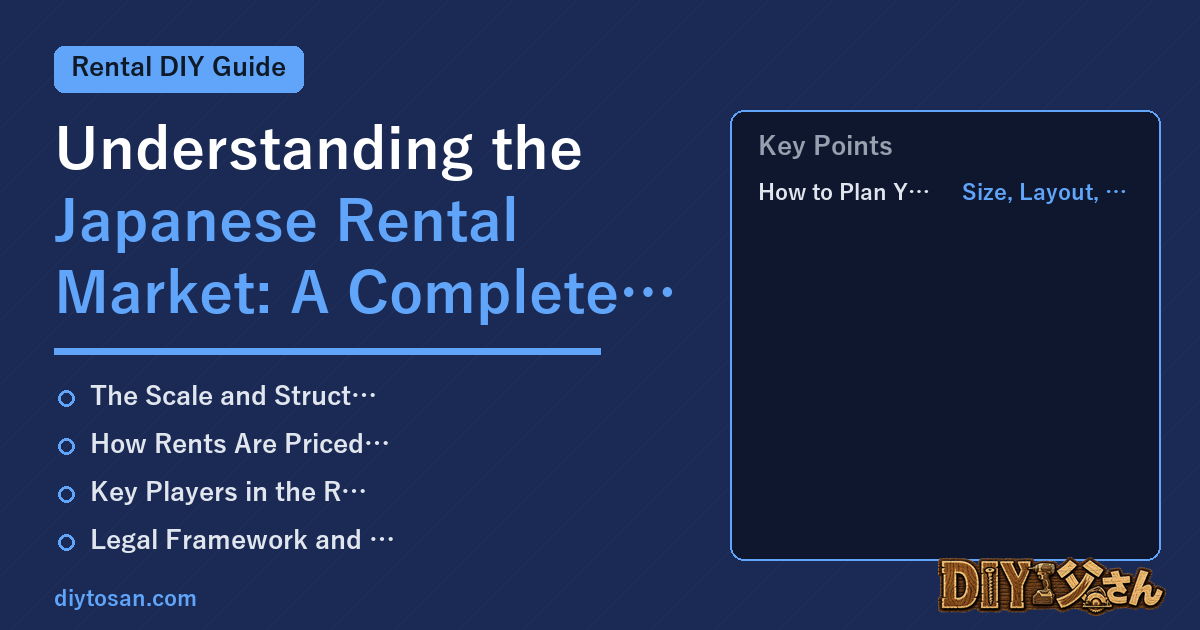
Understanding the Japanese Rental Market: A Complete Overview
Japan’s rental market is unlike anything you’ll find in the West. As a landlord who has managed properties in Japan for years, I want to give you a clear picture of how this market operates u2014 the rules, the customs, and the quirks that define it. Whether you’re a foreigner thinking about investing here or a Japanese property owner trying to understand your own market better, this overview will give you the foundation you need.
The Scale and Structure of the Market
ud83duded2 RECOMMENDED PRODUCTS
Japan Real Estate Investment Guides
Understand the market before you enter it u2014 these books accelerate your learning curve.
Japan has one of the largest rental housing markets in the developed world. Roughly 35% of Japanese households rent their homes, and in major cities like Tokyo and Osaka, that figure climbs even higher u2014 often above 50%. The market is dominated by private landlords, not large institutional investors. Many properties are owned by ordinary families who inherited land or bought apartments as long-term investments.
The rental housing stock spans a wide range: from tiny 1R (one-room) studio apartments of 20 square meters to large family-sized units, from prewar wooden buildings to modern high-rises. The most common unit types are defined by a Japanese shorthand system using numbers and letters u2014 1K, 1DK, 1LDK, 2LDK, and so on. The number refers to the number of bedrooms; K means kitchen, D means dining room, L means living room.
How Rents Are Priced and Who Sets Them
ud83duded2 RECOMMENDED ON AMAZON US
Japanese Language Textbooks (N3 Level)
Reading contracts in Japanese removes your dependence on agents and translators.
Rent in Japan is typically quoted as a monthly figure. Unlike some countries where utilities are bundled, Japanese leases almost always quote rent separately from utilities. Landlords set asking rents based on local comparable properties, building age, floor level, proximity to train stations, and unit size.
Train station proximity is especially important. In Japan, being a five-minute walk from a major station can mean a premium of 10u201320% over an otherwise identical apartment 15 minutes away. This reflects how dependent urban Japanese life is on public transit. As a landlord, understanding the rail network serving your property is essential to pricing correctly.
Rent negotiation is common but subtle. Tenants rarely negotiate aggressively; instead, agents act as intermediaries and quietly test whether a landlord will accept a small discount. Landlords who price competitively from the start tend to fill vacancies faster and avoid the slow drain of extended vacancy periods.
Key Players in the Rental Transaction
Most rental transactions in Japan involve a real estate agent (u4e0du52d5u7523u4ef2u4ecbu696du8005, fudosan chukai gyosha). The agent handles advertising, tenant screening, paperwork, and contract signing. Landlords typically pay the agent a fee equivalent to one month’s rent when a tenant is placed. In some markets, this fee is split between landlord and tenant, but in Tokyo it is often charged entirely to the tenant.
Beyond agents, many landlords use property management companies (u7ba1u7406u4f1au793e, kanri gaisha) to handle day-to-day operations: collecting rent, responding to tenant inquiries, coordinating repairs. Self-managing landlords do exist, but it requires a good grasp of Japanese law and communication skills.
Legal Framework and Tenant Protections
ud83duded2 RECOMMENDED PRODUCTS
Due Diligence Checklists & Guides
Never skip due diligence. These tools help you ask the right questions.
Japan’s rental market is governed primarily by the Borrowing and Lending of Land and Houses Law (u501fu5730u501fu5bb6u6cd5, shakuchi shakkya ho) and the Civil Code (u6c11u6cd5, minpo). Japanese law historically favored tenants strongly u2014 evicting a tenant, even for legitimate reasons, was notoriously difficult. While recent reforms have improved the situation slightly for landlords, tenant protections remain robust.
Most leases are standard fixed-term leases of two years (u666eu901au501fu5bb6u5951u7d04, futsu shakka keiyaku). These automatically renew unless either party gives notice. There are also fixed-term leases (u5b9au671fu501fu5bb6u5951u7d04, teiki shakka keiyaku) that do not renew automatically u2014 these give landlords more control but are less popular with tenants.
Understanding these legal foundations is not optional for landlords. They shape everything from how you handle deposits to how you end a tenancy. The good news is that Japan’s system, while complex, is well-documented and courts interpret it consistently.
Challenges Unique to Japan
Japan’s rental market faces several structural pressures that don’t exist elsewhere. An aging and shrinking population means demand in rural and suburban areas is falling. The country has a cultural preference for new construction, which means older buildings depreciate quickly in tenant appeal even when they are structurally sound. And a historically low-interest-rate environment has encouraged overbuilding in some regions, creating excess supply.
At the same time, opportunities exist. Tokyo and other major cities still see healthy demand. The government is actively promoting renovation of older homes. Foreign resident numbers are rising, opening new tenant pools. And technology is slowly modernizing a traditionally paper-heavy industry.
For landlords willing to understand the system deeply, Japan offers stable returns, a culture of tenants who treat properties with care, and a legal framework that u2014 despite its complexity u2014 is ultimately predictable. That predictability is worth a great deal.
Complete Roadmap: First Rental Property in Japan
Everything I wish I knew before my first purchase u2014 financing, due diligence, negotiation, and year-one management guide.
ud83cudfe0 More from DIY Father
15 years of landlord experience u00b7 3 apartment buildings u00b7 DIY renovations that saved millions of yen. Browse all articles at diytosan.com