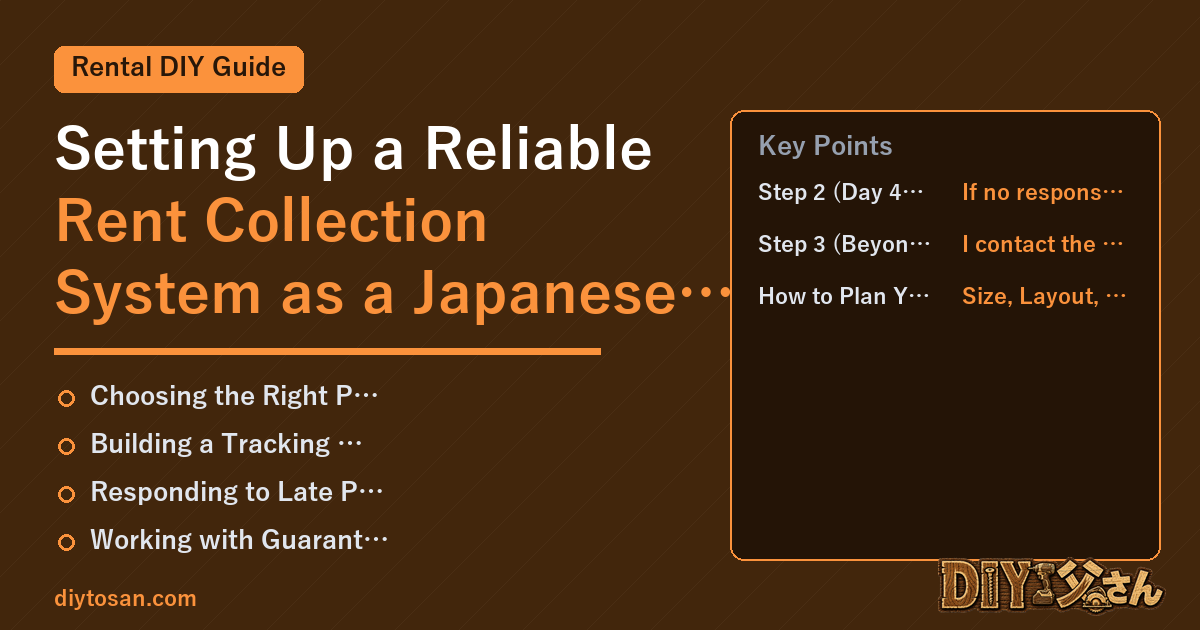
Setting Up a Reliable Rent Collection System as a Japanese Landlord
Rent collection sounds simple until you have three tenants, two of whom pay on different days, one who occasionally forgets, and no system to track any of it. Early in my landlord career I was mentally tracking rent payment status in my head, which meant I sometimes didn’t notice a late payment for two weeks. Now I have a documented, largely automated system that flags issues within 24 hours of the due date. Here’s how I built it.
Choosing the Right Payment Method
ud83duded2 RECOMMENDED ON AMAZON US
Top Property Management Books
Build the knowledge base that separates professional landlords from amateur ones.
The vast majority of Japanese landlords collect rent via bank transfer (furikomi). The tenant transfers a fixed amount to the landlord’s designated account by a specified date each month u2014 typically the end of the month for the following month, or the 25th for the current month. This is clean, auditable, and avoids the awkwardness of cash collection.
I use a separate bank account exclusively for rental income. This isn’t optional for me u2014 it makes accounting infinitely simpler, and it’s essential for tax documentation. Mixing rental income with personal accounts turns tax preparation into archaeology.
Some newer landlords use QR code payment systems or landlord-specific platforms like Itandibb or REINS-connected services. These can be convenient but usually come with fees. For the volume I manage personally, a dedicated bank account with manual tracking works fine.
What I always specify in the lease:
- Exact due date (the specific date each month, not just “end of month”)
- The bank account details in full (bank name, branch, account type, account number)
- That bank transfer fees are the tenant’s responsibility
- Late fee terms u2014 I charge a daily penalty of 0.1% of monthly rent after a three-day grace period, which is standard and legally defensible
Building a Tracking System That Actually Works
ud83duded2 RECOMMENDED PRODUCTS
Landlord-Tenant Law Guides
Know exactly what you can and cannot do u2014 essential reading before any dispute.
After trying various approaches, I landed on a combination of a bank notification app and a simple spreadsheet. Here’s the setup:
- My rental bank account sends an automatic email notification every time a deposit is received. I get the notification same-day.
- I maintain a monthly tracking spreadsheet with one row per unit, columns for each month, and a simple color code: green for paid, yellow for paid late, red for unpaid/overdue.
- On the second business day after the due date, if no payment notification has arrived, I do a manual check and contact the tenant if needed.
This system takes about fifteen minutes per month to maintain. It gives me a complete payment history for every tenant, which is invaluable for lease renewal decisions and for supporting any formal late-payment process.
Responding to Late Payments: The Three-Step Approach
Late payments happen. A tenant forgets, or they’re waiting for a paycheck, or there’s a bank error. How I respond in the first 24 to 48 hours of lateness sets the tone for the entire situation.
My three-step approach:
- Step 1 (Day 1-3 after due date): A brief, friendly message via Line u2014 “Hi [name], I noticed I haven’t received this month’s rent yet. Could you confirm the transfer date? Please let me know if there’s any issue.” Most late payments resolve here. The tenant apologizes and transfers within 24 hours.
- Step 2 (Day 4-7): If no response or no payment, I send a more formal written notice (naiyou shoumeishomemorandum u2014 not necessarily a legal notice, but something in writing) stating the amount overdue, the late fee accrued, and a deadline for payment. I also make a phone call.
- Step 3 (Beyond 7 days): I contact the guarantee company (if enrolled) and inform them of the non-payment. They will begin their own collection process. If there is no guarantee company, I consult with a judicial scrivener about a formal demand letter.
I never skip steps or jump straight to threats. Escalating too fast damages the relationship and can actually make collection harder. Escalating too slowly signals to the tenant that late payment has no consequences.
Working with Guarantee Companies on Chronic Late Payers
ud83duded2 RECOMMENDED PRODUCTS
Property Inspection Forms & Checklists
Document everything. A signed checklist at move-in prevents every deposit dispute.
If I have a tenant enrolled with a guarantee company (hoshougaisha) and they miss rent, the guarantee company typically pays me the overdue amount within one to two months and then pursues the tenant directly. This is the main practical value of guarantee companies u2014 I get paid even if the tenant doesn’t pay, and I’m not the one making uncomfortable collection calls.
However, guarantee companies don’t solve the underlying problem. A tenant who repeatedly can’t pay rent is a tenant who will eventually have to leave. I use the guarantee company’s payment as a buffer while I assess the situation and, if appropriate, begin the process of non-renewal at the next contract term.
A reliable rent collection system is the foundation of financially sustainable self-management. Every missed payment that isn’t flagged promptly is money that may be lost permanently. I treat my rent tracking with the same discipline I’d apply to invoicing in any other business, because that’s exactly what it is.
Property Management Company Evaluation u2014 12-Point Checklist
Developed after switching management companies twice. Saves you from costly mistakes that took me years to learn.
ud83cudfe0 More from DIY Father
15 years of landlord experience u00b7 3 apartment buildings u00b7 DIY renovations that saved millions of yen. Browse all articles at diytosan.com