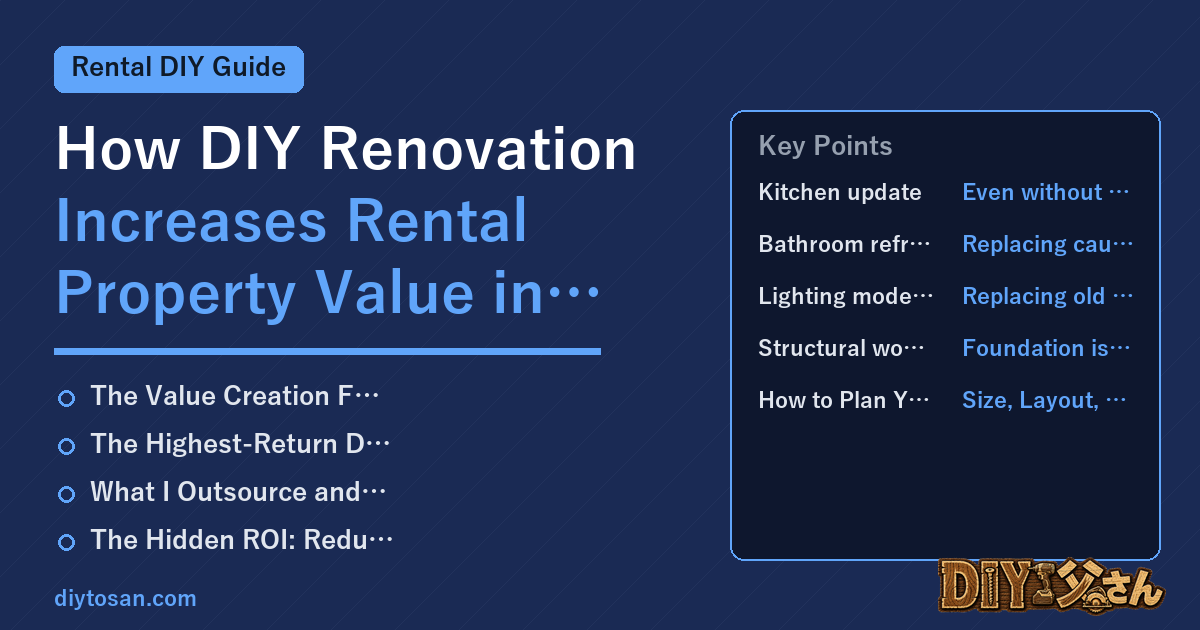
How DIY Renovation Increases Rental Property Value in Japan
Here’s the honest reason I became a DIY landlord: I ran the numbers and realized that every yen I saved on renovation work went directly into my return on investment. A contractor might charge 300,000 yen to repaint and refresh a unit. I can do the same work for 60,000 yen in materials plus my own time. That 240,000 yen difference is real money, and across a portfolio of 20 units, it adds up to millions of yen over a decade. Let me show you exactly how DIY renovation creates value in the Japanese rental market.
The Value Creation Formula: Forced Appreciation
ud83duded2 RECOMMENDED ON AMAZON US
Real Estate Investment Books
The books that changed how I think about money, leverage, and long-term wealth.
Unlike stocks, real estate is an asset you can physically improve. The technical term for this is “forced appreciation”u2014you increase value through action rather than waiting for the market to move.
In Japan’s rental market, forced appreciation works through rent improvement. If your renovation allows you to charge 8,000 yen more per month per unit, that additional cash flow increases the income-based value of your property proportionally.
Using a capitalization rate approach: if similar properties in your area sell at an 8% cap rate, each 100,000 yen increase in annual net operating income adds 1,250,000 yen to the income-based property value.
My concrete example: I renovated a 4-unit building and increased average rent by 10,000 yen per unit. Annual income increase: 480,000 yen. At an 8% cap rate, the value increase implied by that income improvement: 6,000,000 yen. My renovation cost: 1,800,000 yen. I created 4.2 million yen in value on a 1.8 million yen investment.
The Highest-Return DIY Projects in Japanese Rentals
ud83duded2 RECOMMENDED ON AMAZON US
Financial Calculators for Investors
Run yield and cash-flow calculations in seconds u2014 worth every yen on your first deal.
Not all renovation work has equal impact on rent and tenant quality. After years of experimenting, here are the projects I prioritize:
- Full interior repaint (u5168u5ba4u5857u308au66ffu3048): Nothing transforms a unit more dramatically for less money. I do this myself with water-based paint and a roller. Cost per 1K unit: 15,000-25,000 yen in materials. Impact: massive. Japanese tenants equate fresh paint with cleanliness and care.
- Flooring replacement (u5e8au6750u5f35u308au66ffu3048): Old tatami replaced with modern vinyl flooring (u30afu30c3u30b7u30e7u30f3u30d5u30edu30a2) or laminate changes the entire feel of a unit. I’ve learned to lay floor materials myself. Cost per unit for vinyl floor: 20,000-40,000 yen in materials.
- Kitchen update: Even without replacing the entire kitchen, replacing a stained sink, updating the range hood filter, and repainting cabinet faces makes a dramatic difference. My kitchen refresh projects run 30,000-70,000 yen.
- Bathroom refresh: Replacing caulk, cleaning grout with professional products, replacing the toilet seat, and installing a new showerhead costs 10,000-20,000 yen and makes an old bathroom look reasonably new.
- Lighting modernization: Replacing old fluorescent fixtures with LED lighting improves aesthetics and reduces electricity consumption. Modern ceiling lights cost 5,000-15,000 yen each and I install them myself (after confirming I’m working safely with the circuit off).
What I Outsource and Why
I’m honest about the limits of my DIY skills. There are tasks I always hire out:
- Licensed electrical work (u96fbu6c17u5de5u4e8b): Anything beyond simple fixture replacement requires a licensed electrician in Japan. Doing it yourself without a license is illegal. I use a trusted local electrician who gives me competitive rates because I send him steady work.
- Plumbing that involves gas (u30acu30b9u5de5u4e8b): Gas line work requires a licensed professional. Non-negotiable.
- Structural work: Foundation issues, load-bearing wall modificationsu2014these go to professionals every time.
- Asbestos-containing material work: If I suspect materials contain asbestos (common in pre-1990 Japanese construction), I stop, get testing done, and hire licensed abatement contractors.
The Hidden ROI: Reduced Vacancy Through Better Units
ud83duded2 RECOMMENDED PRODUCTS
Investment Analysis Templates
Spreadsheet analysis is the difference between a good deal and a disaster.
The financial return on DIY renovation isn’t just higher rentu2014it’s also lower vacancy. A renovated, well-maintained unit rents faster than an old, tired unit. In my experience, renovated units lease 2-4 weeks faster than comparable unrenovated units in the same area.
At 50,000 yen per month in rent, 3 fewer weeks of vacancy per turnover saves 37,500 yen. Over 20 tenant turnovers across my portfolio, that’s 750,000 yen in saved vacancy costsu2014a meaningful addition to the renovation ROI calculation.
There’s also a quality-of-tenant effect. Better-condition units attract tenants who take better care of them, which reduces damage at turnover and reduces ongoing maintenance costs. This is harder to quantify but completely real.
The DIY landlord model isn’t for everyone. It requires time, physical effort, and a willingness to spend weekends with a paintbrush instead of at a restaurant. But for me, the financial return and the satisfaction of watching a shabby unit transform into something attractiveu2014and then housing someone who treats it wellu2014makes it worth every hour.
Property Cash Flow Calculator + Complete Guide
The exact Excel spreadsheet I use for every property purchase decision u2014 5-year projection, yield calculation, and break-even analysis included.
ud83cudfe0 More from DIY Father
15 years of landlord experience u00b7 3 apartment buildings u00b7 DIY renovations that saved millions of yen. Browse all articles at diytosan.com
💡 DIY工具・建材はヤフーショッピングで
DIYに必要な工具・建材はヤフーショッピングで。送料無料商品多数。