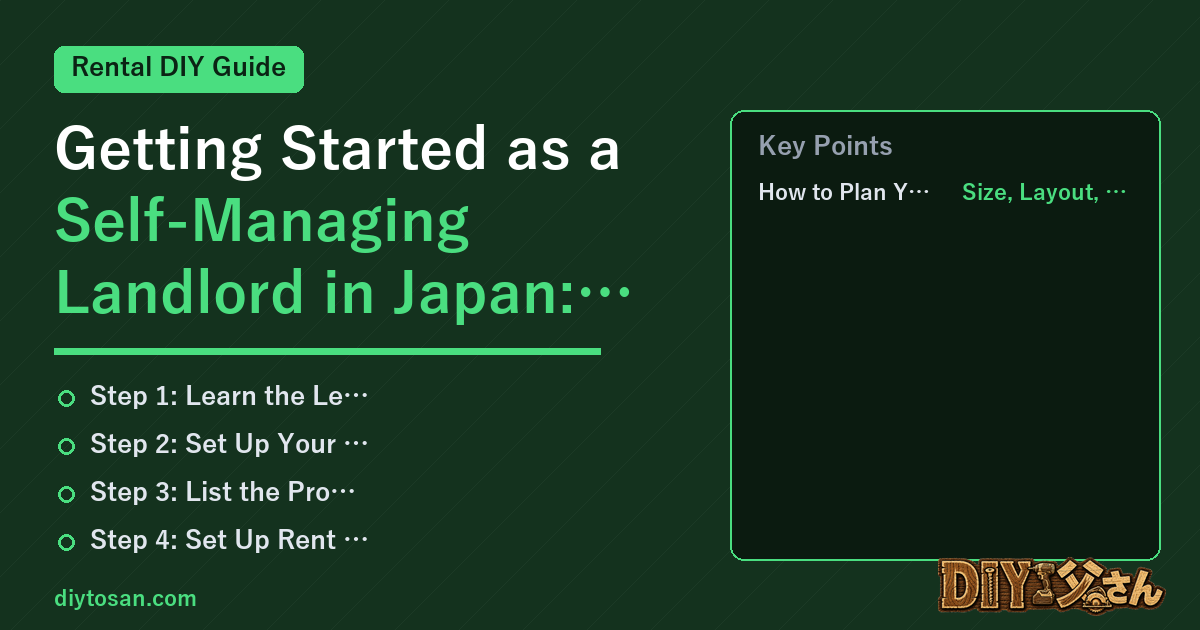
Getting Started as a Self-Managing Landlord in Japan: The Complete Roadmap
Managing your own rental property in Japan u2014 without delegating to a management company u2014 is demanding but entirely achievable. Many landlords do it successfully, saving on management fees and maintaining direct relationships with their tenants. I have been self-managing properties for years, and I can tell you that the learning curve is real but not insurmountable. Here is the complete roadmap for getting started, based on what I wish someone had told me before I began.
Step 1: Learn the Legal Framework Before You Do Anything Else
ud83duded2 RECOMMENDED PRODUCTS
Japan Real Estate Investment Guides
Understand the market before you enter it u2014 these books accelerate your learning curve.
Self-managing in Japan without understanding the legal framework is like driving without knowing the traffic rules. The key laws you need to understand are the Building Standards Act (u5efau7bc9u57fau6e96u6cd5), the Borrowing and Lending of Land and Houses Law (u501fu5730u501fu5bb6u6cd5), and the 2020-revised Civil Code provisions on leases, deposits, and guarantors. You do not need to become a lawyer, but you need a functional understanding of tenant rights, deposit rules, eviction standards, and what you can and cannot put in a lease contract.
Good starting resources include the Ministry of Land, Infrastructure, Transport and Tourism’s guideline on security deposit handling (available in Japanese on their website), your prefectural real estate association’s standard lease forms (which encode best practices for your region), and general introductory books on landlord-tenant law published for property owners.
Step 2: Set Up Your Property for Self-Management
ud83duded2 RECOMMENDED ON AMAZON US
Japanese Language Textbooks (N3 Level)
Reading contracts in Japanese removes your dependence on agents and translators.
Before listing your property, make sure it is physically and administratively ready. Physically: conduct a thorough inspection covering all major systems (plumbing, electrical, HVAC, roof, exterior), and address any issues that could affect habitability or lead to emergency calls in the first few months of a tenancy. Photograph every room and every surface, dated, as your move-in record.
Administratively: confirm your property’s registration (u767bu8a18u7c3f, toki bo) is accurate and up to date. Verify zoning compliance u2014 that the property can legally be used for the intended rental purpose. Confirm your fire safety compliance: smoke detectors are legally required in all residential units in Japan. Make sure you have building insurance and, if applicable, earthquake insurance.
Prepare your key documents: a lease agreement based on your region’s standard form, a move-in condition checklist, a house rules document covering garbage separation, noise, and facility use, and any required disclosure documents.
Step 3: List the Property and Screen Tenants
Self-managing landlords typically still use a licensed real estate agent to list and place their first tenant. Even if you intend to handle everything else yourself, having an agent handle listing, viewings, and initial screening is efficient and legally cleaner u2014 agents are licensed to conduct the legally required u91cdu8981u4e8bu9805u8aacu660e (juyou jiko setsumei, important matters explanation) that must be given to tenants before signing.
Provide the agent with clear information about your property, your target tenant profile (in terms of income, employment stability, and household type u2014 not ethnicity or nationality), and your position on reikin, deposit, and rent. Clarify whether you will use a guarantee company and which ones you accept.
When the agent brings you an applicant’s screening package, review it carefully. Confirm employment, income (a general guideline is rent should not exceed 30% of monthly income), and guaranty arrangements. Do not rush this step. A well-screened tenant who pays reliably and maintains the property carefully is worth waiting for.
Step 4: Set Up Rent Collection and Maintenance Systems
ud83duded2 RECOMMENDED PRODUCTS
Due Diligence Checklists & Guides
Never skip due diligence. These tools help you ask the right questions.
For rent collection, bank transfer (u632fu8fbc, furikomi) is standard in Japan. Establish a dedicated bank account for rental income. Provide the tenant with your account details and confirm the expected transfer date each month (typically the end of the month preceding or the start of the current month). Set up simple tracking u2014 even a spreadsheet u2014 so you know immediately if a payment is late.
For maintenance, build a short list of reliable contractors before your first tenant moves in: a plumber, an electrician, and a general handyman who handles minor repairs. In Japan, finding reliable local contractors can take time u2014 having relationships established before an emergency is far better than scrambling during one. Ask neighbors, local hardware stores, or your real estate agent for recommendations.
Establish a clear process for maintenance requests: how tenants should report issues (text message, email, phone call), what constitutes an emergency requiring immediate response, and your standard response time commitment. Communicating this clearly at move-in sets expectations and reduces conflict.
Step 5: Manage Ongoing Tenancy and Plan for Transitions
During the tenancy, your main responsibilities are: timely response to maintenance requests, annual fire safety equipment checks (often required by local fire departments), lease renewal management at the end of each two-year term, and prompt follow-up if rent payments are late.
Plan for lease renewal several months in advance. Send a renewal notice to the tenant, confirm their intention to stay or leave, and if staying, confirm whether rent terms will remain the same or be adjusted. Keep records of all communications in writing.
When a tenancy ends, conduct a thorough move-out inspection jointly with the tenant, document everything photographically, prepare a fair and itemized deposit accounting, and return the deposit balance within a reasonable time. A clean, professional move-out process protects your reputation and makes the next tenant search easier.
Self-managing is not a set-and-forget operation. But for landlords who engage with it genuinely, it offers control, cost savings, and direct relationships with the people who live in your properties u2014 which, done well, is genuinely rewarding.
Complete Roadmap: First Rental Property in Japan
Everything I wish I knew before my first purchase u2014 financing, due diligence, negotiation, and year-one management guide.
ud83cudfe0 More from DIY Father
15 years of landlord experience u00b7 3 apartment buildings u00b7 DIY renovations that saved millions of yen. Browse all articles at diytosan.com