How to Choose the Right Drill for Property Maintenance Work
Walk into any Cainz or Konan in Japan and you’ll find an entire wall dedicated to drills. Cordless, corded, hammer, rotary, drill-drivers, impact drivers u2014 the terminology alone is enough to send a new landlord home empty-handed. After years of using drills for everything from hanging curtain rails to replacing bathroom tile, I’ve developed a clear framework for choosing the right drill for rental property work.
Understanding the Three Types of Drills
ud83duded2 RECOMMENDED PRODUCTS
18V Professional Impact Driver
My most-used tool. If you own one power tool, make it this.
Before you can choose the right drill, you need to understand what each type actually does.
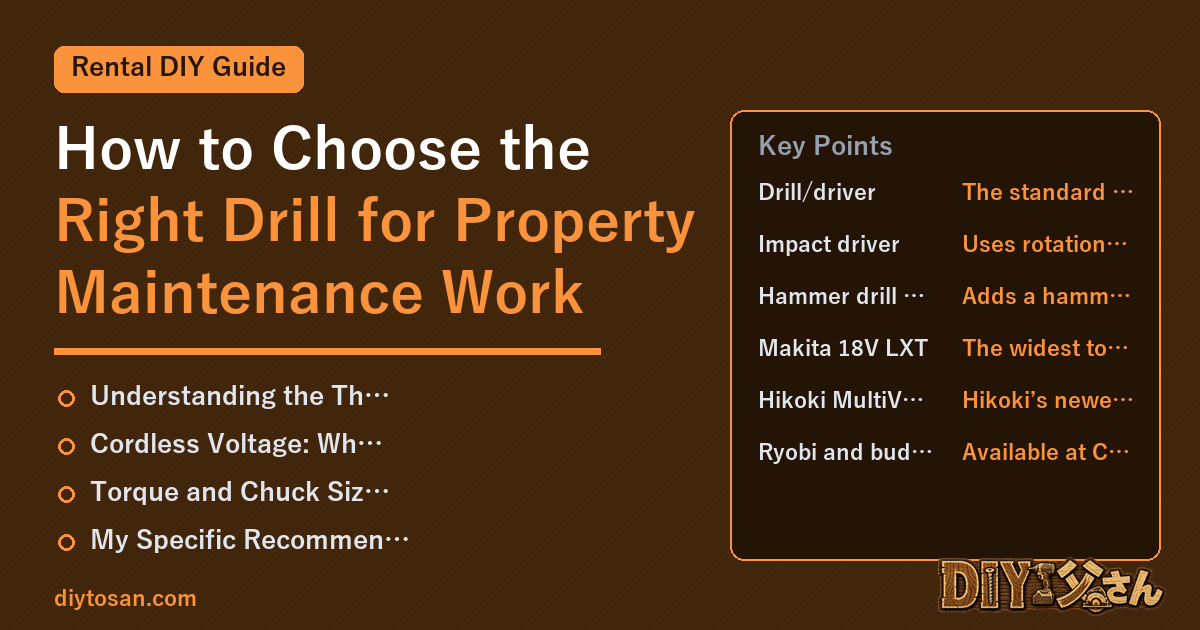
- Drill/driver: The standard tool for driving screws and boring holes in wood, drywall, and light metal. The clutch mechanism prevents overdriving screws, which is critical when working with the thin wall panels common in Japanese rental units. This is the type most landlords should buy first.
- Impact driver: Uses rotational impact blows to drive fasteners with higher torque than a standard drill. Excellent for flooring projects, decking, and any job with many screws. Not ideal for boring clean holes because the impact action causes bit wobble.
- Hammer drill / rotary hammer: Adds a hammering action for drilling into masonry, concrete, and tile. For most Japanese residential work u2014 attaching grab bars, mounting TV brackets on concrete walls, anchoring shelving u2014 a hammer drill mode is useful. Full rotary hammers (SDS-plus chuck) are for heavy concrete work.
Cordless Voltage: Which Platform to Choose
ud83duded2 RECOMMENDED PRODUCTS
Power Tool Combo Kit (18V)
Combo kits are always better value than individual tools u2014 one battery charges all.
In Japan, the two dominant professional platforms are Makita’s 18V LXT and Hikoki’s 18V/36V MultiVolt. For landlords, either works well. The key decision is picking one and sticking with it, since batteries between brands are not interchangeable.
- Makita 18V LXT: The widest tool selection in Japan. The DF486D drill/driver (around u00a518,000u2013u00a522,000 body-only) is the benchmark mid-range option. Reliable, widely available for service, and backed by a huge selection of compatible tools. If you’re starting fresh, this platform is the safest bet.
- Hikoki MultiVolt 18V/36V: Hikoki’s newer batteries work at both 18V and 36V depending on the tool. This means buying into the platform now gives you access to 36V tools (like their circular saws and angle grinders) in the future without changing batteries. The DS18DBL2 (around u00a517,000u2013u00a521,000 body-only) is their mid-range drill/driver equivalent.
- Ryobi and budget brands: Available at Cainz and Konan for u00a55,000u2013u00a510,000, these are fine for occasional light use. If you’re doing one repair per year, a budget drill works. For landlords doing regular maintenance, the cheaper motors and batteries don’t last and cost more over time.
Torque and Chuck Size: What the Numbers Mean
Torque is measured in Newton-meters (Nm) and determines how powerful the drill is. For property maintenance work, a drill with 40u201360Nm of torque is sufficient for most tasks u2014 driving screws into wooden framing, boring holes in wall panels, light masonry with a carbide bit. You only need more if you’re regularly drilling large-diameter holes (38mm+) in hardwood or light concrete.
Chuck size matters too. A 13mm chuck accepts larger drill bits than a 10mm chuck. For general property maintenance, 13mm is more versatile, but the difference is marginal for most tasks landlords face. More important is whether the chuck is keyless u2014 all modern professional drills have keyless chucks, so bit changes take seconds.
The clutch setting is underrated. When driving screws into the thin wall panels and flooring systems common in Japanese rentals, an adjustable clutch prevents stripping screw heads and blowing through materials. Start with a low clutch setting and work up u2014 it’s a habit that saves a lot of frustration.
My Specific Recommendations by Budget
ud83duded2 RECOMMENDED PRODUCTS
Tool Storage & Workshop Organizer
A well-organized toolbox saves 20 minutes on every job. Multiply that by 100 repairs.
- Under u00a515,000 (body-only): Ryobi R18DD3 or the Cainz store-brand 18V drill. Adequate for light maintenance tasks. Expect to replace the battery pack in 2u20133 years.
- u00a515,000u2013u00a525,000 (body-only): Makita DF486D or Hikoki DS18DBL2. The sweet spot for most landlords. Professional-grade reliability, serviceable parts, batteries that last 5+ years with normal use.
- u00a525,000+ (body-only): Makita DF637D (brushless motor) or Hikoki DS36DA (36V). Brushless motors run cooler, more efficiently, and last significantly longer. Worth the premium if you’re doing heavy renovation work between tenants regularly.
One final note: buy the tool body only and purchase a separate battery kit if you’re building a platform. Two 5.0Ah batteries and a dual charger run u00a512,000u2013u00a516,000 for either Makita or Hikoki, and those batteries will power everything else you buy in the same lineup.
ud83cudfe0 More from DIY Father
15 years of landlord experience u00b7 3 apartment buildings u00b7 DIY renovations that saved millions of yen. Browse all articles at diytosan.com