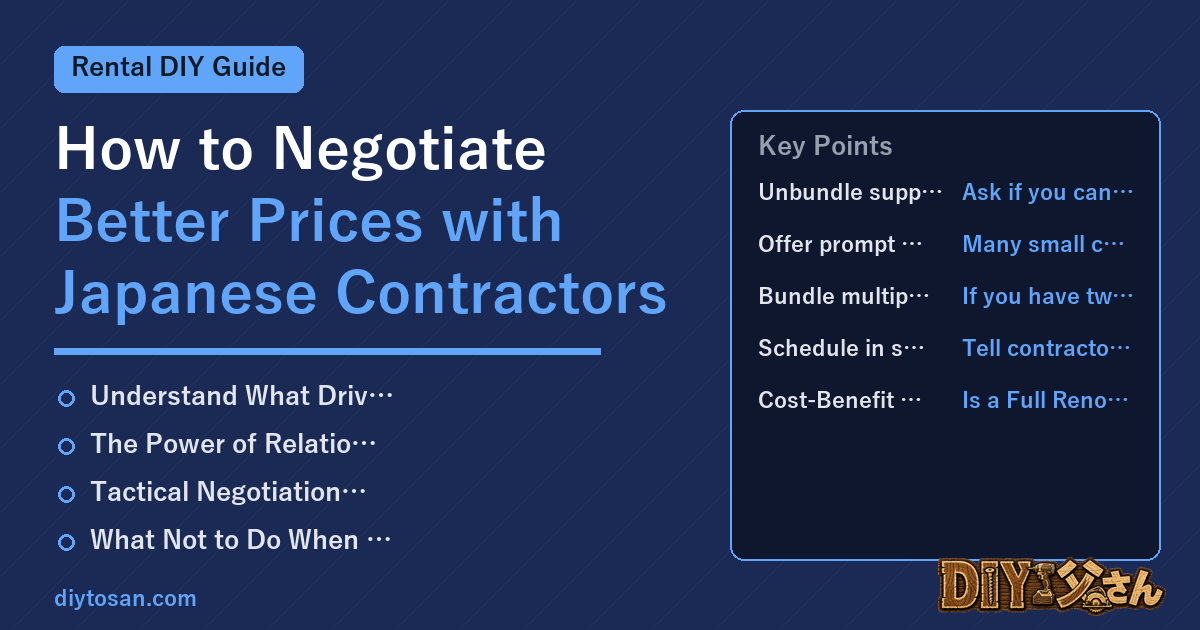
How to Negotiate Better Prices with Japanese Contractors
Japan has a reputation as a country where price negotiation is awkward or culturally inappropriate. That reputation is partly true in retail settings, but in the context of construction and renovation contracting, negotiation is entirely normal u2014 expected, even. What differs from Western contexts is the style and approach. Negotiating aggressively or treating contractors as adversaries will backfire. But there are very effective ways to secure better pricing while maintaining the respectful relationships that get you good work and reliable service over the long term.
Understand What Drives Contractor Pricing
ud83duded2 RECOMMENDED ON AMAZON US
Personal Finance & Real Estate Books
The financial mindset shift that made property investment possible on a salary.
Before you can negotiate effectively, understand what goes into a contractor’s quote. Japanese renovation contractors typically price as follows: material cost + labor cost + overhead (roughly 20u201330% for a small contractor) + profit margin (typically 15u201325%). When you receive a quote that seems high, the question is which component has room u2014 material markup, labor, overhead, or margin.
Materials can often be sourced more cheaply by you directly (buying flooring, fixtures, or tiles from a home center like Cainz or Kohnan and supplying them to the contractor). Labor is less flexible u2014 skilled labor in Japan commands fixed market rates, and underpaying leads to poor work or contractor resentment. Overhead reflects the contractor’s business structure. Margin is negotiable, especially for larger jobs or ongoing relationships.
Timing also significantly affects price. Contractors are expensive and unavailable during peak season (late March to April, September to October). A job quoted in November for December execution may come in 15u201325% cheaper than the same job in April.
The Power of Relationship and Repeat Business
ud83duded2 RECOMMENDED ON AMAZON US
Budget Planners for Property Owners
Track every yen in and out u2014 the foundation of profitable landlord accounting.
In Japanese business culture, long-term relationships (u9577u3044u4ed8u304du5408u3044) matter deeply. A contractor who sees you as a one-time customer has no incentive to sharpen their pencil. A contractor who sees you as the source of 3u20134 renovation jobs per year, plus potential referrals, will actively work to give you favorable pricing to protect the relationship.
My most practical negotiating tool is a simple statement, offered genuinely: “I have three properties I manage myself, and I am looking for contractors I can work with regularly over the years. If we build a good working relationship, I can bring you consistent business.” This is not manipulation u2014 it is an accurate description of what you offer as a landlord client, and it reframes the conversation from a one-shot transaction to a long-term partnership.
After your first project with a new contractor, if the work quality meets your standards, tell them explicitly that you want to continue working with them and ask them to give you their “repeat customer rate” (u9867u5ba2u5272u5f15 or simply u5c11u3057u30b5u30fcu30d3u30b9u3057u3066) on future projects. Many will agree, and the discount does not need to be large u2014 5u201310% consistently adds up significantly over many projects.
Tactical Negotiation Approaches That Work in Japan
- Get three quotes, then disclose the range: After collecting three quotes, you can honestly say to your preferred contractor, “I have received other quotes that come in lower. I prefer working with you u2014 can you review your estimate?” This is direct but not aggressive, and gives them a face-saving reason to sharpen their number.
- Unbundle supply and labor: Ask if you can supply materials yourself. Many contractors will provide a labor-only quote, which is harder to inflate. You then buy materials from your preferred supplier (often at the same or better price than the contractor pays).
- Offer prompt payment: Many small contractors in Japan operate with tight cash flow and have receivables stretching 30u201360 days with larger clients. Offering to pay within 3u20135 days of completion u2014 in cash or bank transfer u2014 is genuinely valuable and often worth a 5u20138% discount without any other negotiation required.
- Bundle multiple units: If you have two or three units in the same building that need similar work, negotiate for all of them together. The contractor saves mobilization costs and can schedule efficiently u2014 pass those savings to you.
- Schedule in slow periods: Tell contractors you are flexible on timing and ask when they have open capacity. Filling a slow week costs them nothing in opportunity cost and may generate a willingness to discount.
What Not to Do When Negotiating with Japanese Contractors
ud83duded2 RECOMMENDED PRODUCTS
Tax Guides for Property Investors
Knowing the tax rules turns a good investment into a great one.
Aggressive hardball tactics that might work in some Western contexts tend to destroy relationships in Japan. Avoid: demanding an immediate price reduction without explanation, implying that their quote is unreasonably high or their business is overpriced, using price as your only criteria and ignoring quality and reliability, and pressuring for discounts repeatedly even after agreement has been reached.
The contractors who will serve you best over 10u201320 years of property ownership are the ones who feel respected and fairly compensated, who pick up the phone when you call, and who prioritize your jobs when you need them urgently. That reliability has real financial value u2014 a contractor who responds to an emergency call in 4 hours versus 4 days can mean the difference between u00a530,000 in repair costs and u00a5300,000 in water damage. Guard those relationships by treating price negotiation as finding a fair deal, not winning at the other person’s expense.
Renovation Cost Reduction Checklist (60% Savings Method)
My step-by-step process management template that cut renovation costs by 60% across 3 apartment buildings over 15 years.
ud83cudfe0 More from DIY Father
15 years of landlord experience u00b7 3 apartment buildings u00b7 DIY renovations that saved millions of yen. Browse all articles at diytosan.com