Building a Repair Budget for Your Rental Property Portfolio
Most landlords in Japan either spend too little on maintenance budgeting u2014 and then scramble when a major repair hits u2014 or they set arbitrary reserves that have no relationship to the actual condition of their properties. After managing multiple rental units for over a decade, I have developed a systematic approach that keeps my finances stable even when a hot water heater fails in January or a roof needs emergency patching after a typhoon.
The 1% Rule vs. Reality in Japan
ud83duded2 RECOMMENDED ON AMAZON US
Personal Finance & Real Estate Books
The financial mindset shift that made property investment possible on a salary.
In American real estate circles, there is a popular rule of thumb: budget 1% of the property’s value annually for maintenance and repairs. In Japan, this rule does not translate cleanly because property values, particularly for older wooden or light-steel apartment buildings, do not reflect replacement cost. A building worth u00a58,000,000 on paper may cost u00a515,000,000 to rebuild u2014 or it may not be worth rebuilding at all.
A more useful framework for Japanese rental properties is to budget based on per-unit annual allowances, adjusted by building age:
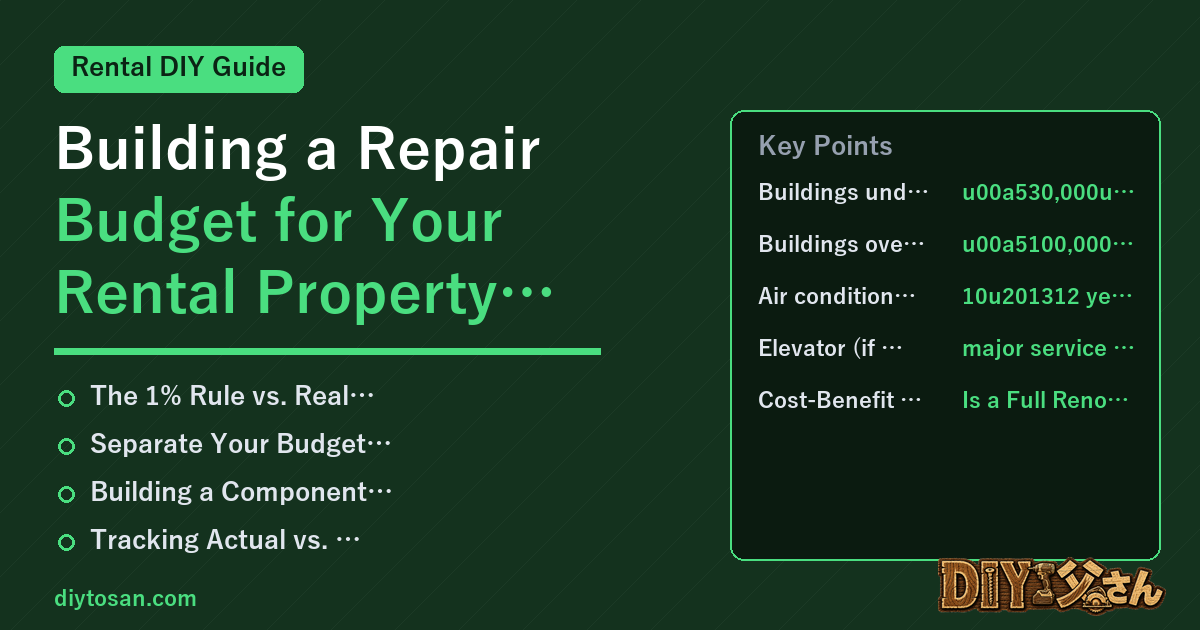
- Buildings under 15 years old: u00a530,000u2013u00a550,000 per unit per year
- Buildings 15u201330 years old: u00a560,000u2013u00a5100,000 per unit per year
- Buildings over 30 years old: u00a5100,000u2013u00a5180,000 per unit per year
These are not renovation budgets. They cover routine repairs: faucet washers, caulking, door lock cylinders, light fixtures, small appliance replacements, and touch-up painting. Major renovations u2014 the full unit refresh between tenants u2014 are a separate line item.
Separate Your Budget into Three Buckets
ud83duded2 RECOMMENDED ON AMAZON US
Budget Planners for Property Owners
Track every yen in and out u2014 the foundation of profitable landlord accounting.
I manage my repair budget with three distinct buckets, each serving a different purpose and drawn from separately:
Bucket 1 u2014 Routine Maintenance (monthly allocation). This covers anything under u00a550,000 that keeps the property functional during a tenancy. Replacing a shower head, fixing a sliding door track, repairing a window screen. I allocate u00a55,000u2013u00a58,000 per unit per month into this bucket and handle most of it myself with DIY when the repair allows.
Bucket 2 u2014 Turn Costs (per-vacancy allocation). Every time a tenant vacates, I expect to spend u00a5100,000u2013u00a5350,000 on the unit depending on condition and how long they lived there. This bucket is funded by setting aside a portion of each month’s rent u2014 typically u00a58,000u2013u00a515,000 per unit u2014 into a dedicated bank account I never touch except for vacancies.
Bucket 3 u2014 Capital Reserve (annual lump sum). Large, infrequent items: roof waterproofing, exterior painting, staircase handrail replacement, water pipe replacement. I estimate the remaining useful life of each major building component and divide the replacement cost by the years remaining. For a roof with an estimated u00a5800,000 replacement cost and 10 years of useful life remaining, I set aside u00a580,000 per year in this bucket.
Building a Component Lifespan Spreadsheet
The capital reserve bucket only works if you know your building’s major components and their expected lifespans. Walk through your property and list every component that will eventually need replacement. Typical lifespans for common items in Japanese rental properties are:
- Unit bath (u30e6u30cbu30c3u30c8u30d0u30b9): 20u201325 years
- Kitchen (u30b7u30b9u30c6u30e0u30adu30c3u30c1u30f3): 15u201320 years
- Water heater (u7d66u6e6fu5668): 10u201315 years
- Air conditioner: 10u201312 years
- Roof waterproofing (u9678u5c4bu6839): 10u201315 years
- Exterior paint (u5916u58c1u5857u88c5): 10u201315 years
- Elevator (if applicable): major service every 5 years, replacement at 20u201325 years
- Water pipes (galvanized steel): replacement at 30u201340 years
For each item, record the install year (or estimated age), estimated replacement cost, and the annual reserve required. Sum all the annual reserves to get your capital reserve target. If the total seems daunting compared to your rental income, prioritize by risk: safety items and water-related items first, cosmetic items last.
Tracking Actual vs. Budgeted Spending
ud83duded2 RECOMMENDED PRODUCTS
Tax Guides for Property Investors
Knowing the tax rules turns a good investment into a great one.
A budget means nothing if you do not track actuals against it. I use a simple spreadsheet with a column for budget and a column for actual spend, reviewed monthly. When actual spending exceeds budget in any bucket, I do a brief post-mortem: was this a one-time surprise, or does it signal that my budget assumption is wrong?
After three to five years of careful tracking, your historical data becomes more valuable than any rule of thumb. I can now predict within about 10% how much a vacancy will cost me based solely on the unit size, tenant tenure, and building age u2014 because I have 12 years of actual data from my own properties. Start tracking today, even if your first year is rough. The data you build is one of the most valuable assets in your portfolio.
Renovation Cost Reduction Checklist (60% Savings Method)
My step-by-step process management template that cut renovation costs by 60% across 3 apartment buildings over 15 years.
ud83cudfe0 More from DIY Father
15 years of landlord experience u00b7 3 apartment buildings u00b7 DIY renovations that saved millions of yen. Browse all articles at diytosan.com