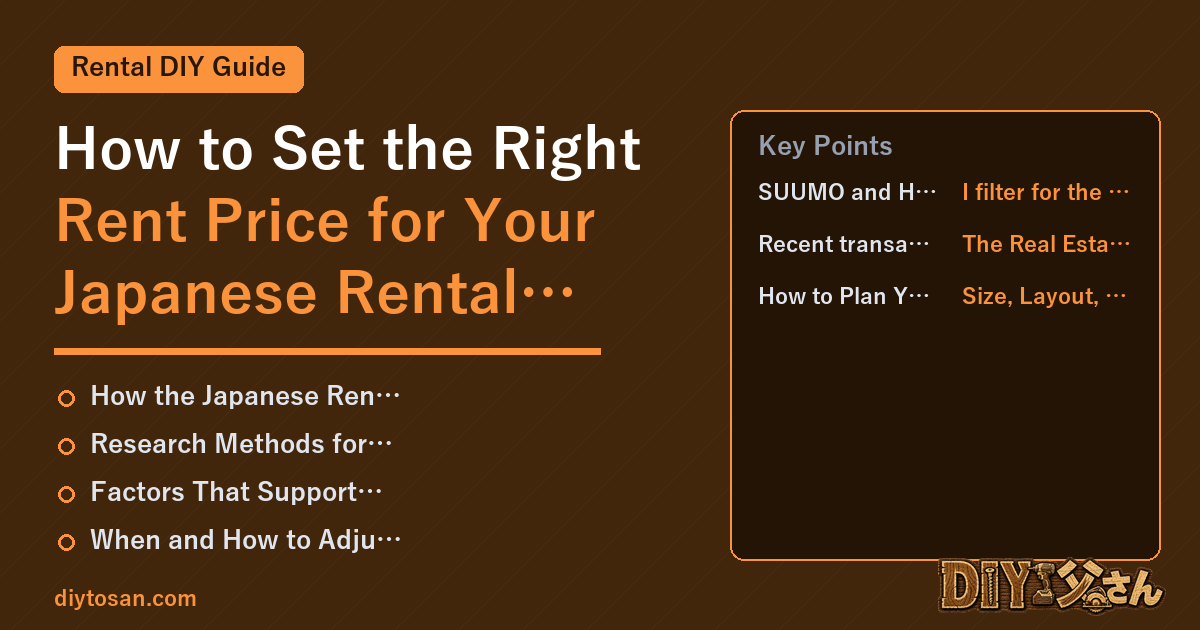
How to Set the Right Rent Price for Your Japanese Rental Property
Pricing a rental unit is one of those decisions that feels like it should have an obvious answer u2014 but it’s actually one of the most nuanced calls in property management. Price too high and the unit sits empty for months, costing more in lost rent than any premium could recover. Price too low and you’re leaving money on the table every month, permanently, for the duration of a multi-year tenancy. Getting it right requires systematic research, honest assessment of your property’s strengths, and a willingness to adjust.
How the Japanese Rental Market Works
ud83duded2 RECOMMENDED ON AMAZON US
Top Property Management Books
Build the knowledge base that separates professional landlords from amateur ones.
Japan’s rental market has several characteristics that affect pricing strategy. First, there’s a strong seasonality: the peak search period runs from January through March as people prepare for the April job and school start. Listing a vacancy in February at a slight premium is often possible; listing the same unit in August means competing with lower overall demand and may require a discount to move quickly.
Second, Japanese renters are relatively price-sensitive to monthly rent and often less sensitive to one-time costs like key money. This means that reducing monthly rent by 3,000 yen is often more effective at attracting applications than eliminating a 60,000-yen key money charge u2014 even though the math clearly favors the latter for any tenancy longer than 20 months.
Third, common area charges (kyoueki-hi) are technically separate from rent in Japan but matter to tenants’ total monthly cost calculation. If your kyoueki-hi is significantly higher than comparable properties, factor that into how you present the total cost in your listing.
Research Methods for Comparable Pricing
ud83duded2 RECOMMENDED PRODUCTS
Landlord-Tenant Law Guides
Know exactly what you can and cannot do u2014 essential reading before any dispute.
My standard research process whenever I’m setting or reviewing rent:
- SUUMO and HOME’S searches: I filter for the same area (typically within a 10-minute walk of the nearest station), same unit type (1K, 1LDK, 2LDK, etc.), and similar floor area (within 10 square meters). I look at the full range of current asking prices and note where my unit would fit based on its condition and features.
- Recent transaction data: The Real Estate Information Network (REINS) data isn’t publicly accessible to individuals, but some aggregator sites provide historical transaction data. Chintai-soba tools on SUUMO and the Land Information System (tochi soujou jouhoukan) from the Ministry give some useful pricing context.
- Talk to local real estate agents: I spend an hour every year or so having coffee with the real estate agent I work with and asking directly: what are units like mine renting for right now, and how long are they typically sitting on the market? Agents have real-time market data that no website shows.
Factors That Support a Price Premium
Not all units in the same area deserve the same price. These factors legitimately support charging more than the average comparable:
- Recently renovated kitchen or bathroom u2014 tenants will pay more for a modern, clean kitchen
- Floor level u2014 upper floors command premiums in Japan, both for light/view and for perceived security
- Southern or southeastern exposure u2014 critical in Japan for winter warmth and overall light quality; north-facing units discount
- A parking space included or available u2014 in areas with limited street parking, this is significant
- Newer appliances, particularly a high-quality water heater, modern bathroom fixtures, and built-in air conditioning
- Proximity to major train stations u2014 the premium for being within five minutes’ walk versus fifteen minutes’ walk is measurable and consistent
When and How to Adjust Rent
ud83duded2 RECOMMENDED PRODUCTS
Property Inspection Forms & Checklists
Document everything. A signed checklist at move-in prevents every deposit dispute.
For existing tenants, rent increases in Japan require written notice and, in practice, the tenant’s agreement. Under an ordinary lease, a landlord can request a rent increase if rents in the area have risen substantially, but a tenant can refuse, and the landlord cannot unilaterally increase rent without going through a formal process (typically arbitration at the local rent tribunal). This means that setting the right rent at the start of a tenancy is far more important than trying to adjust it later.
For vacant units I’m re-listing, I reassess rent every time. If a unit has been listed for three weeks without serious inquiries, I consider a 3,000 to 5,000 yen reduction. If inquiries are strong but applications aren’t converting, the price may be right but another factor (photos, listing description, condition) needs attention.
One approach I’ve found effective: I list the unit at a slight premium initially, then make a visible price reduction after two to three weeks. The “price reduction” label (nedan kakusage or nedan sagari) on listing platforms generates new attention from people who had already seen and dismissed the listing at the original price. A 5,000-yen reduction can reactivate ten inquiries that went cold.
Property Management Company Evaluation u2014 12-Point Checklist
Developed after switching management companies twice. Saves you from costly mistakes that took me years to learn.
ud83cudfe0 More from DIY Father
15 years of landlord experience u00b7 3 apartment buildings u00b7 DIY renovations that saved millions of yen. Browse all articles at diytosan.com