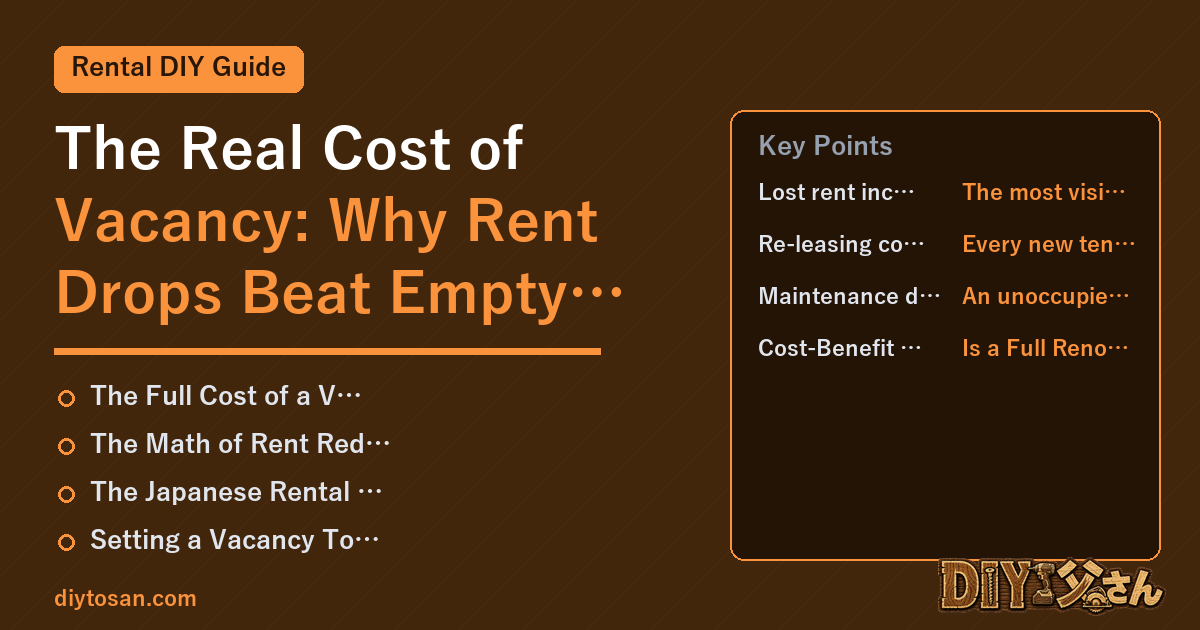
The Real Cost of Vacancy: Why Rent Drops Beat Empty Units
Many Japanese landlords hold out for their target rent even as months tick by with no tenant. Their logic feels sound: accepting a lower rent means losing money every month permanently. But this reasoning ignores the full cost of vacancy and the mathematics of rent discounts vs. empty units. Once you run the actual numbers, the calculus often points clearly in the direction of a modest rent reduction over extended vacancy.
The Full Cost of a Vacant Unit
ud83duded2 RECOMMENDED ON AMAZON US
Personal Finance & Real Estate Books
The financial mindset shift that made property investment possible on a salary.
The obvious cost of vacancy is zero rental income. But there are additional costs that make vacancy even more expensive than the missing rent check suggests:
- Lost rent income: The most visible cost. A u00a570,000/month unit generates zero during vacancy.
- Fixed expenses that continue regardless: Mortgage payment, property tax (prorated), insurance, management fees, and any utilities in common areas do not stop when the unit is empty.
- Re-leasing costs: Every new tenancy incurs agency fees (typically 1 month’s rent paid by the landlord to the leasing agent, or split with the tenant), plus any contribution to the new tenant’s key money/gift money conventions in your local market.
- Maintenance during vacancy: An unoccupied unit deteriorates. Mold, insects, dust accumulation, and HVAC systems that are not cycled all require attention. A unit vacant for 6+ months often needs additional cleaning before it can be shown.
- Opportunity cost of your time: Showings, negotiations, and paperwork for a new tenant take time that has value.
A fully loaded vacancy cost calculation for a u00a570,000/month unit: u00a570,000 lost rent + u00a535,000 (fixed expenses continuing) + u00a570,000 agency fee + u00a510,000 maintenance during vacancy = u00a5185,000 total cost for just one month of vacancy. For three months, that is u00a5555,000 in total economic loss.
The Math of Rent Reduction vs. Vacancy
ud83duded2 RECOMMENDED ON AMAZON US
Budget Planners for Property Owners
Track every yen in and out u2014 the foundation of profitable landlord accounting.
Now compare that to accepting a reduced rent. Suppose you drop from u00a570,000 to u00a565,000 to attract a tenant immediately. You lose u00a55,000/month u2014 but you gain: immediate income rather than zero, no agency fee for the second re-listing cycle, and no maintenance costs during an extended vacancy.
Break-even calculation: how many months of reduced rent equals one month of vacancy?
Cost of one month vacancy (fully loaded, as above): u00a5185,000. Monthly cost of u00a55,000 rent reduction: u00a55,000. Breakeven: u00a5185,000 u00f7 u00a55,000 = 37 months. In other words, accepting a u00a55,000/month rent reduction is not costlier than one month of vacancy until 37 months into the tenancy u2014 more than three years. If the new tenant stays 3+ years, the rent reduction costs exactly as much as one month of vacancy. If the vacancy would have lasted 2 months, the break-even is 74 months u2014 over six years. The math almost always favors filling the unit quickly over holding out for top rent.
The Japanese Rental Market’s Structural Characteristics
Several features of Japan’s rental market amplify the cost of vacancy relative to Western markets. First, Japanese tenants tend to have very long tenancies once established u2014 average tenancy length in many Japanese markets is 4u20137 years. A tenant who comes in at u00a565,000 will likely stay for years, and you can gradually nudge rent upward at renewal time in a rising market. Second, the up-front costs of moving in Japan (u6577u91d1, u793cu91d1, agency fees, guarantor fees) are substantial for tenants. This means highly qualified tenants are often reluctant to move unless they have strong reason to. Third, the demand for rental units varies dramatically by location u2014 in some rural or suburban markets, a unit can sit vacant for 6u201312 months without a showing if priced above market.
Understanding your local vacancy rate (u7a7au5ba4u7387) is essential context for these decisions. In Tokyo’s central wards, a 3-week vacancy before a new tenant is normal. In a smaller city with an aging population, 3 months might be the expected time to fill a unit even at market rate.
Setting a Vacancy Tolerance Policy
ud83duded2 RECOMMENDED PRODUCTS
Tax Guides for Property Investors
Knowing the tax rules turns a good investment into a great one.
I recommend setting a written vacancy tolerance policy before a unit becomes vacant u2014 not in the heat of the moment when you are tempted to hold out for your target rent. My policy: if a unit has not received a serious application within 4 weeks at asking rent, I reduce by u00a53,000u2013u00a55,000 and restart the clock. If no application within 4 more weeks, I reduce again and also reassess whether other factors (condition, amenities, listing quality) need attention. I have never needed more than two reductions before finding a qualified tenant, and this policy has kept my average vacancy duration under 5 weeks per turnover across my portfolio. The math strongly supports this approach.
Renovation Cost Reduction Checklist (60% Savings Method)
My step-by-step process management template that cut renovation costs by 60% across 3 apartment buildings over 15 years.
ud83cudfe0 More from DIY Father
15 years of landlord experience u00b7 3 apartment buildings u00b7 DIY renovations that saved millions of yen. Browse all articles at diytosan.com