ud83dudcda Wood Deck DIY Guide u2014 7 of 11
u2190 No.7: Choosing Structural Members u00b7 Series Index u00b7 No.9: Strength by the Numbers u2192
Introduction
ud83duded2 RECOMMENDED PRODUCTS
Pressure-Treated Deck Lumber
Pressure-treated lumber is the baseline u2014 skip it and you’ll be rebuilding in 5 years.
Whether or not to add a roof to a wood deck is a more important decision than it might appear.
Adding a roof:
- Dramatically increases comfort
- Extends the usable season considerably
On the other hand:
- It increases the structural load
- The structure becomes one level more complex
- A “figure it out as you go” approach is genuinely dangerous
This article organizes, from a design perspective:
- Why a roof was added
- How the load (especially snow) was accounted for
- How the roles of beams, rafters, and purlins were divided
Why a Roof Was Added to This Wood Deck
ud83duded2 RECOMMENDED PRODUCTS
Deck Stains & Waterproof Sealers
Stain every 2u20133 years. It’s the single cheapest way to double deck lifespan.
The reason is simple.
1. Usage frequency changes dramatically
Without a roof:
- Light rain makes the deck unusable
- Summer sun is harsh
- Floor boards degrade faster
The result is “we put in the effort to build it but never use it.” With a roof, the practical benefits are significant:
- Usable in rainy weather
- Comfortable to spend time on in summer
- Floor board lifespan is extended
2. Retrofitting a roof is nearly impossible
A roof integrated into the structure from the start versus one bolted on later are completely different challenges. Retrofitting often leads to:
- Columns and beams that cannot support the added load
- Inability to achieve proper slope
- Waterproofing failures at junctions
The roof was therefore treated as something that must be decided at the planning stage.
The Most Important Principle in Roof Structure Design
That principle is: “Light roof, strong bones.”
In DIY, using heavy roofing materials or complex structures increases risk substantially. For this reason, the configuration chosen was:
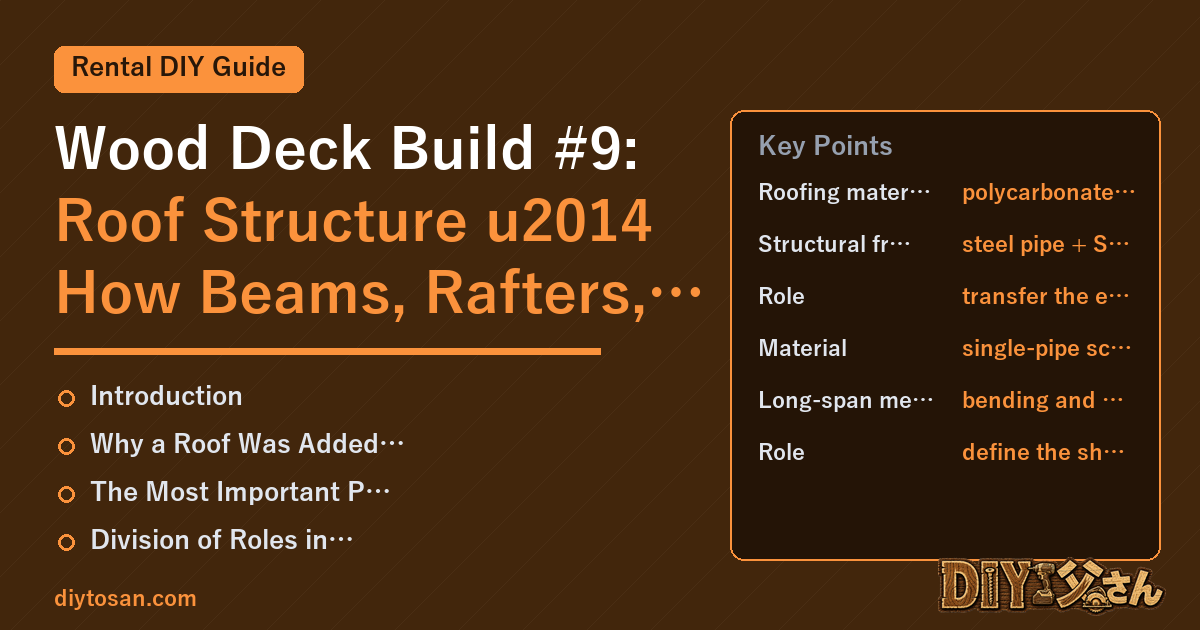
- Roofing material: polycarbonate corrugated sheet
- Structural frame: steel pipe + SPF lumber
Division of Roles in the Roof Structure
ud83duded2 RECOMMENDED PRODUCTS
Deck Screws & Fasteners
Use stainless screws only u2014 standard screws rust and stain the deck within one rainy season.
Each member in the roof structure was given a clearly defined role.
Beams (girders)
- Role: transfer the entire roof load to the columns
- Material: single-pipe scaffolding (Super Light 700)
- Long-span members: bending and deflection were carefully considered
If these are weak, the entire roof becomes unstable.
Rafters
- Role: define the shape of the roof surface
- Material: single-pipe scaffolding
- Function: transfer load from beam to beam
By increasing the number of rafters, the load per rafter is reduced, and the span of the purlins and roofing material is shortened.
Purlins
- Role: support the roofing material
- Material: SPF 1u00d74
- Closely spaced
Purlins are not structural members u2014 they are roofing support members. The design accounts for the possibility of replacing them in the future.
How Snow Load Was Addressed
The most challenging part of the roof design was accounting for snow load.
Assuming zero snow is dangerous
The location does not receive heavy snowfall every year and is not in a designated heavy-snow area. However, a record-breaking snowfall once every several years does happen. Assuming “it won’t accumulate” is a dangerous design assumption.
The approach taken:
- Maximum snow depth: 300 mm
- Treated as a short-term load
- Verified against the short-term allowable stress of the steel pipe
The result was a practical solution where stress stays within short-term allowable limits and some deflection occurs but structural collapse does not.
In DIY, “don’t aim for perfection, but don’t let it fail” is the key mindset.
Why Polycarbonate Corrugated Sheet?
The reasons:
- Lightweight
- Crack-resistant
- Easy to cut and work with
- Works well with steel pipe
Using heavy roofing material leads to a cascade of complexity:
- Beams need to be larger
- More columns are needed
- The foundation work becomes much harder
The key insight is: design the structure around the assumption that a light roofing material will be used.
A Note for Anyone Adding a Roof in a DIY Project
A covered wood deck is a genuine structure. “Just set it on top” is dangerous. At a minimum, understand:
- How loads travel through the structure
- The distinct roles of beams, rafters, and columns
…before starting construction.
Summary
- Decide on the roof during the planning phase
- Clear role division among roof structure members is critical
- Snow load: design for the realistic maximum, not the average
- Light roofing material + strong frame = the DIY-appropriate approach
This approach leads to a wood deck that is safe and long-lasting.
Next Article
NO.10 | Foundation, Weed Control, and Subbase: The Practical Answer
- Why a full engineered foundation was not used
- Thinking through weed barrier fabric and crushed stone
- Realistic subbase preparation for DIY
That’s all for today u2014 see you in the next article!
ud83dudcda Wood Deck DIY Guide u2014 7 of 11
u2190 No.7: Choosing Structural Members u00b7 Series Index u00b7 No.9: Strength by the Numbers u2192
DIY Renovation Quote Review Manual
How to read, compare, and negotiate contractor quotes. This manual saved me u00a5800,000 on a single renovation project.
ud83cudfe0 More from DIY Father
15 years of landlord experience u00b7 3 apartment buildings u00b7 DIY renovations that saved millions of yen. Browse all articles at diytosan.com