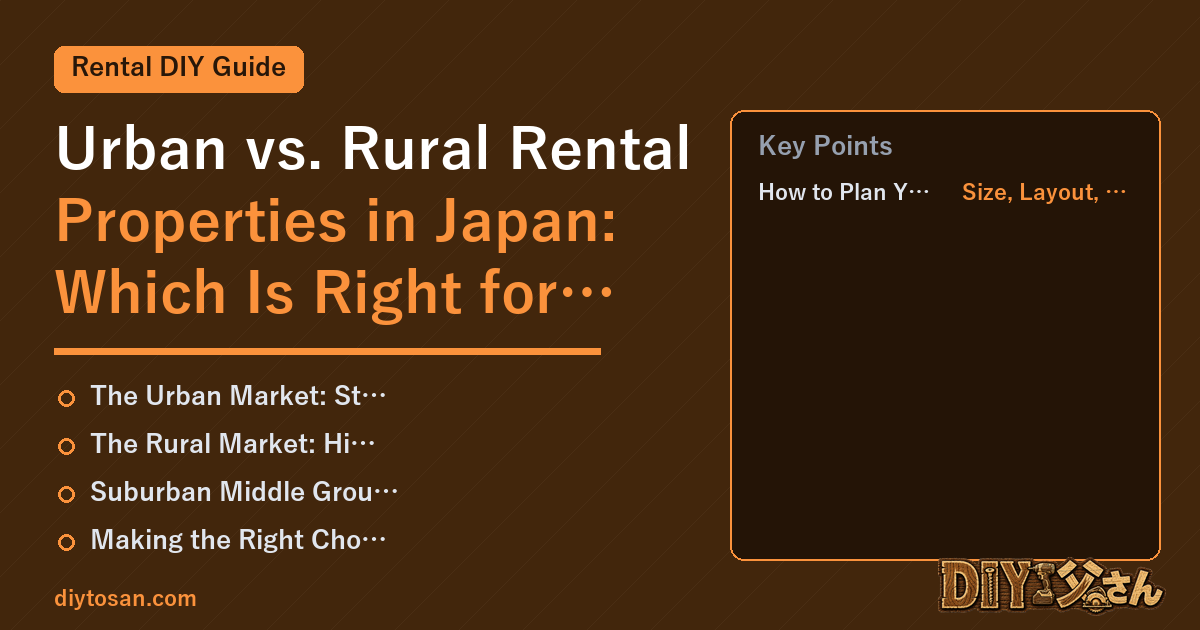
Urban vs. Rural Rental Properties in Japan: Which Is Right for You?
One of the most fundamental decisions a landlord in Japan faces is where to own property. Japan’s urban-rural divide is stark u2014 the country’s population is clustering in a handful of major metropolitan areas while vast swaths of rural Japan are emptying out. Understanding what this means for landlords on both sides of the divide is essential before you buy, inherit, or invest in rental property.
The Urban Market: Stability, Competition, and Higher Entry Costs
ud83duded2 RECOMMENDED PRODUCTS
Japan Real Estate Investment Guides
Understand the market before you enter it u2014 these books accelerate your learning curve.
Tokyo, Osaka, Nagoya, Yokohama, Fukuoka u2014 Japan’s major cities continue to attract population from rural areas and, increasingly, from overseas. Demand for rental housing in these centers remains relatively healthy, particularly in neighborhoods with strong train access and proximity to employment.
Urban properties command higher rents in absolute terms. A 1LDK in central Tokyo might rent for 120,000u2013150,000 yen per month; the same unit in a regional city might fetch 50,000u201370,000 yen. However, purchase prices in urban areas are also dramatically higher, so the yield (annual rent divided by property price) is often lower in cities than in rural areas, counterintuitively.
Urban rental markets are competitive. Tenants have choices, and poorly maintained or awkwardly priced properties sit vacant. But vacancies in healthy urban neighborhoods, if they occur, are measured in weeks rather than years. The liquidity of urban property u2014 your ability to sell if needed u2014 is also far higher than for rural real estate.
The Rural Market: Higher Yields, Higher Risk, and a Shrinking Pool
ud83duded2 RECOMMENDED ON AMAZON US
Japanese Language Textbooks (N3 Level)
Reading contracts in Japanese removes your dependence on agents and translators.
Rural Japan presents a very different picture. Purchase prices are low u2014 sometimes astonishingly so. Akiya (u7a7au304du5bb6, vacant houses) in rural areas are sometimes sold for nominal amounts or even given away. The stated rental yield on paper can look attractive because the denominator (purchase price) is so small.
The problem is demand. Rural Japan is losing population steadily. Young people leave for cities; the elderly who remain eventually enter care facilities or pass away, leaving more homes vacant. A property that has tenants today may face genuine difficulty attracting the next tenant after a vacancy opens up. In the most depopulated areas, it may be nearly impossible to rent at all.
Rural properties also require more hands-on management. Tenants tend to be older, potentially needing more support. Maintenance contractors are harder to find and may charge a premium to travel to remote locations. Property management companies may not operate in some rural areas, forcing self-management.
Suburban Middle Ground
Between dense urban cores and rural countryside lies Japan’s vast suburban belt u2014 commuter towns within 30u201390 minutes of major cities by train. These areas often offer a more balanced risk-return profile than either extreme.
Suburban properties can be purchased at significantly lower prices than city centers while still attracting tenants who work in the city and prefer more space for their families. Demand is more stable than in deep rural areas because commuters value the train connection to employment. Rents are lower than urban properties, but so are purchase prices, and yields are often competitive.
The risk in suburban markets is that population decline, when it reaches them, can move quickly. A suburban town that feels stable today may face meaningful depopulation in 10u201320 years as its working-age population ages. Researching local population projections u2014 available from each municipality and the National Institute of Population and Social Security Research u2014 before buying suburban property is worth doing.
Making the Right Choice for Your Situation
ud83duded2 RECOMMENDED PRODUCTS
Due Diligence Checklists & Guides
Never skip due diligence. These tools help you ask the right questions.
- If you prioritize stability and liquidity, urban properties in major cities are the safest choice despite lower yields.
- If you are considering rural property, look carefully at local population trends, not just current vacancy rates.
- If you own rural property already, explore whether renovation and repositioning u2014 such as targeting remote workers or tourism u2014 could improve its rental prospects.
- Suburban properties near train stations in growing or stable commuter areas can offer a good balance, but require careful research.
- Never buy rural property solely on the basis of a high paper yield u2014 demand sustainability is more important than the initial calculation.
There is no universally correct answer. The right choice depends on your financial goals, risk tolerance, management capacity, and local knowledge. But understanding the structural forces shaping each type of market puts you in a much stronger position to make a decision you won’t regret.
Complete Roadmap: First Rental Property in Japan
Everything I wish I knew before my first purchase u2014 financing, due diligence, negotiation, and year-one management guide.
ud83cudfe0 More from DIY Father
15 years of landlord experience u00b7 3 apartment buildings u00b7 DIY renovations that saved millions of yen. Browse all articles at diytosan.com