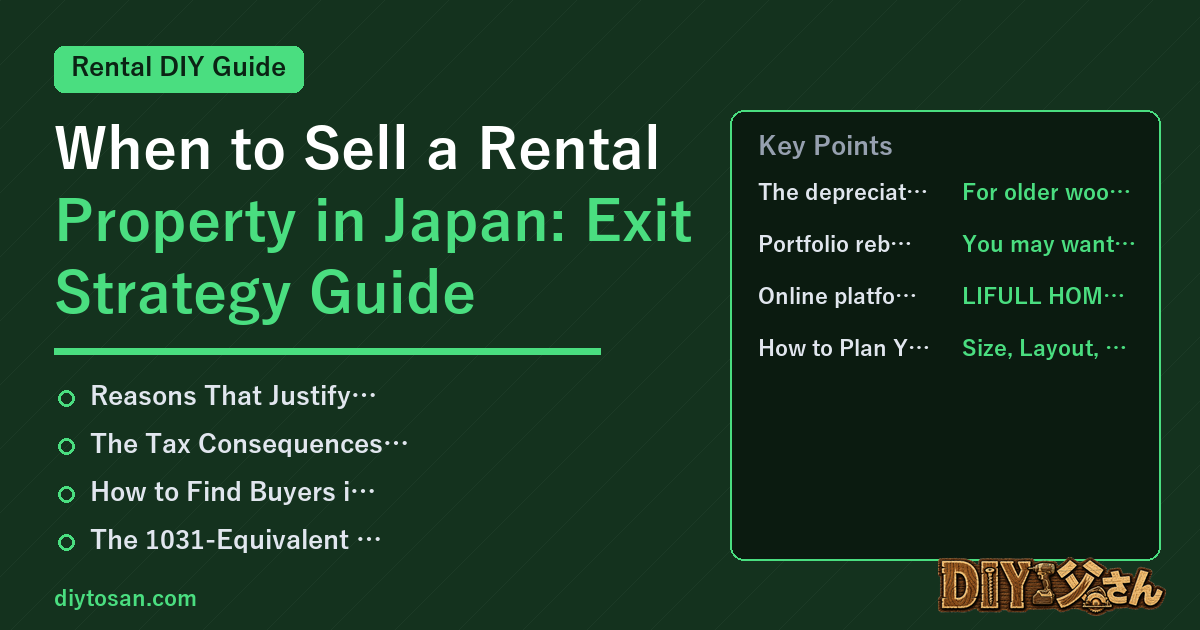
When to Sell a Rental Property in Japan: Exit Strategy Guide
I sold one of my properties two years ago. It was a decision I’d been considering for three years, and when I finally executed it, I felt both relief and mild regret. Knowing when to hold and when to sell is one of the harder judgment calls in real estate investingu2014especially in Japan, where the rules around capital gains and the market’s unique dynamics affect the optimal timing significantly.
Reasons That Justify Selling
ud83duded2 RECOMMENDED ON AMAZON US
Real Estate Investment Books
The books that changed how I think about money, leverage, and long-term wealth.
Not every property deserves to stay in your portfolio forever. Here are legitimate reasons to sell:
- The neighborhood fundamentals have deteriorated: Population decline has accelerated beyond your original projections. The anchor employer has left. Vacancy in the area is rising and your property is increasingly difficult to fill. If the location thesis no longer holds, don’t wait for things to get worse.
- The property needs more capital than it can return: Major structural issues, necessary seismic reinforcement, or aging systems (plumbing, electrical, roof) requiring investment that exceeds the property’s remaining income-generating potential.
- The depreciation has run out: For older wood-frame properties, once the building is fully depreciated, your taxable income from the property jumps significantly. Selling can reset the depreciation clock on a new property.
- You can redeploy the equity more productively: If your property has limited remaining upside and you can identify a better opportunity, selling and reinvesting in higher-yield assets may make sense.
- Portfolio rebalancing: You may want to reduce leverage as you approach retirement, or shift from older maintenance-intensive properties to newer, more passive ones.
The Tax Consequences of Selling in Japan
ud83duded2 RECOMMENDED ON AMAZON US
Financial Calculators for Investors
Run yield and cash-flow calculations in seconds u2014 worth every yen on your first deal.
Capital gains tax on real estate in Japan depends primarily on how long you’ve held the property:
- Short-term gain (u77edu671fu8b72u6e21u6240u5f97): Property held 5 years or less at the time of sale. Tax rate: 39.63% (national 30% + local 9% + reconstruction special surtax).
- Long-term gain (u9577u671fu8b72u6e21u6240u5f97): Property held more than 5 years. Tax rate: 20.315% (national 15% + local 5% + reconstruction special surtax).
The capital gain is calculated as: Sale price u2212 (Purchase price u2212 Accumulated depreciation taken) u2212 Selling costs
Note the critical issue: because you’ve been taking depreciation deductions during ownership, your tax basis is reduced by the amount of depreciation claimed. This means the taxable gain on sale can be larger than the actual appreciation in market value. This is called “depreciation recapture” and it catches some investors off guard.
I held the property I sold for 7 years, which qualified for long-term treatment. Even so, the tax bill was substantial. Work with your tax accountant to model the after-tax proceeds before deciding to sell.
How to Find Buyers in Japan
Selling investment property in Japan typically involves:
- Listing with investment property specialists: Agencies like Ken Corporation, Relo Total Facility, and smaller regional firms that specialize in income-producing properties. These agencies have networks of qualified investors.
- Online platforms: LIFULL HOME’S (u30e9u30a4u30d5u30ebu30dbu30fcu30e0u30ba), AtHome, and Rakuten Real Estate all have investment property sections where you can reach a broad audience.
- Direct marketing to known investors: If you’ve been active in real estate investor circles (u5927u5bb6u306eu4f1a, local investor meetups), fellow investors may be interested buyers.
Pricing realistically is crucial. Japanese investment property buyers are sophisticated and will run the same cash flow analysis you ran when you bought. Pricing based on what you need rather than what the market will bear is a common seller mistake that leads to properties sitting unsold for months.
The 1031-Equivalent in Japan: Like-Kind Exchanges
ud83duded2 RECOMMENDED PRODUCTS
Investment Analysis Templates
Spreadsheet analysis is the difference between a good deal and a disaster.
Japan does not have a direct equivalent to the US 1031 like-kind exchange (tax-deferred exchange). Capital gains tax is generally due in the year of sale regardless of whether you reinvest.
There are some specific exemption provisions for cases involving government expropriation or certain rebuilding scenarios, but these are narrow. The general rule is: plan for the tax liability as part of your exit calculation. Don’t be surprised when the proceeds from your sale are materially reduced by the tax obligation.
The best approach is to hold properties long enough to qualify for long-term capital gains treatment (over 5 years) and to time major sales in years when your other income is lower, which may reduce your overall effective tax rate on the blended income.
Property Cash Flow Calculator + Complete Guide
The exact Excel spreadsheet I use for every property purchase decision u2014 5-year projection, yield calculation, and break-even analysis included.
ud83cudfe0 More from DIY Father
15 years of landlord experience u00b7 3 apartment buildings u00b7 DIY renovations that saved millions of yen. Browse all articles at diytosan.com