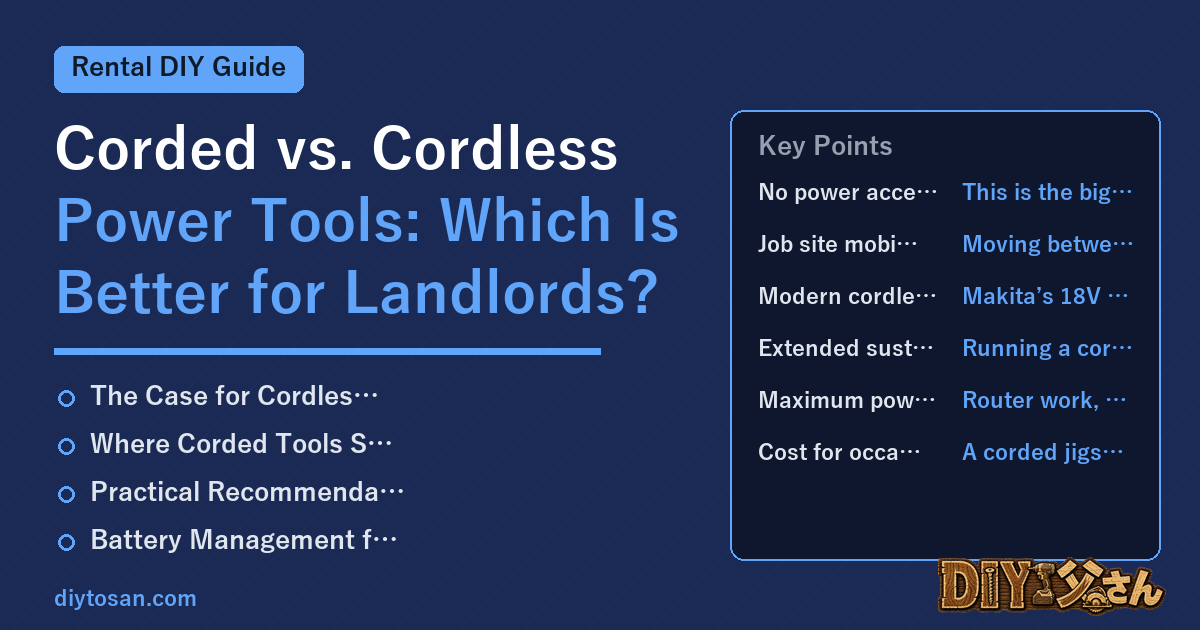
Corded vs. Cordless Power Tools: Which Is Better for Landlords?
When I started managing properties, cordless tools were a nice luxury. Today, they’re genuinely competitive with corded in almost every category. But “almost” is doing a lot of work in that sentence. For landlords doing property maintenance in Japan, the corded vs. cordless decision involves practical considerations beyond raw tool performance. Here’s the complete breakdown.
The Case for Cordless Tools
ud83duded2 RECOMMENDED PRODUCTS
18V Professional Impact Driver
My most-used tool. If you own one power tool, make it this.
The modern argument for cordless is compelling and I’ll state it plainly: for most landlord tasks, a high-quality 18V cordless tool is fully adequate, and the convenience advantages are real.
- No power access problems: This is the biggest practical advantage for landlord work. Rental units between tenants often have the power turned off, or the circuits you need are on the wrong side of the unit. Cordless tools mean you can work anywhere, anytime, without running extension cords or waiting for utilities to be reconnected.
- Single-battery platform efficiency: Standardize on Makita 18V LXT or Hikoki MultiVolt and your batteries are interchangeable across your entire kit u2014 drill, impact driver, circular saw, jigsaw, sander, light, and more. One set of charged batteries powers a full day of work across multiple tools.
- Job site mobility: Moving between rooms, floors, and buildings without managing cords saves time and reduces tripping hazards. On a day when you’re making repairs at multiple units across a building, cordless is the clear choice.
- Modern cordless performance: Makita’s 18V brushless drill, circular saw, and jigsaw all perform within 15u201320% of their corded equivalents for the sustained loads typical in property maintenance. For most landlord tasks u2014 driving screws, cutting panels, sanding surfaces u2014 this performance gap is invisible in practice.
Where Corded Tools Still Win
ud83duded2 RECOMMENDED PRODUCTS
Power Tool Combo Kit (18V)
Combo kits are always better value than individual tools u2014 one battery charges all.
There are specific applications where corded remains the better choice, and an honest assessment requires acknowledging them.
- Extended sustained use: Running a cordless circular saw through 20 sheets of 24mm structural plywood will drain two 5.0Ah batteries. The same job with a corded saw runs until the outlet is free. If you do high-volume cutting work regularly u2014 full-unit flooring replacement, major wall repairs u2014 a corded circular saw alongside your cordless kit makes sense.
- Maximum power applications: Router work, sustained grinding, and high-torque drilling in concrete all benefit from unlimited power delivery. A corded angle grinder (running u00a55,000u2013u00a58,000 for a quality Hikoki or Makita 125mm model) pulls 840u20131000W continuously; a cordless equivalent pulls maybe 700W at peak, declining as the battery depletes.
- Cost for occasional use: A corded jigsaw costs u00a56,000u2013u00a510,000. A cordless equivalent body-only costs u00a510,000u2013u00a518,000. If you use a jigsaw twice a year and already have a good cordless drill, a corded jigsaw is a perfectly rational purchase.
Practical Recommendations by Tool Type
- Drill/driver: Cordless, always. The convenience advantage is overwhelming and modern cordless drills are fully capable. Makita DF486D or Hikoki DS18DBL2 are the go-to choices.
- Impact driver: Cordless. Same reasoning as drill/driver.
- Circular saw: For occasional use, cordless is fine. For frequent heavy cutting, consider keeping a corded Makita HS6601 (around u00a515,000u2013u00a518,000) alongside your cordless kit.
- Jigsaw: Either works. If you already have the cordless platform, get a cordless jigsaw body. If not, the Makita 4329K corded model (around u00a59,000) is excellent value.
- Sander: Cordless is convenient but corded sanders provide more consistent power for extended sanding sessions. The Makita BO5030K corded sander (around u00a58,000) is a landlord classic for good reason.
- Angle grinder: For occasional light work, cordless works. For tile cutting and extended grinding, corded is superior and cheaper.
Battery Management for Landlords
ud83duded2 RECOMMENDED PRODUCTS
Tool Storage & Workshop Organizer
A well-organized toolbox saves 20 minutes on every job. Multiply that by 100 repairs.
The one genuine hassle with cordless is battery management. Here’s the system that works for me:
- Keep two batteries per voltage platform minimum. One charges while one works. Four batteries total u2014 two smaller (3.0Ah) for light tools, two larger (5.0Ah) for circular saw and heavier work u2014 is a comfortable setup for a busy maintenance day.
- Store batteries at partial charge (40u201360%) if you won’t use them for weeks. Lithium batteries stored fully charged lose capacity faster.
- Keep a dual charger at your work vehicle or storage location, not at your home. Batteries charge on the way to the next job.
- Budget for battery replacement every 4u20136 years with regular use. Replacement battery packs from Makita or Hikoki cost u00a55,000u2013u00a510,000 each u2014 factor this into your tool cost calculations.
The short answer for most landlords in Japan: go cordless for your primary tools and keep one or two corded tools for the applications where you genuinely need more power or runtime. Don’t let perfect be the enemy of practical.
ud83cudfe0 More from DIY Father
15 years of landlord experience u00b7 3 apartment buildings u00b7 DIY renovations that saved millions of yen. Browse all articles at diytosan.com