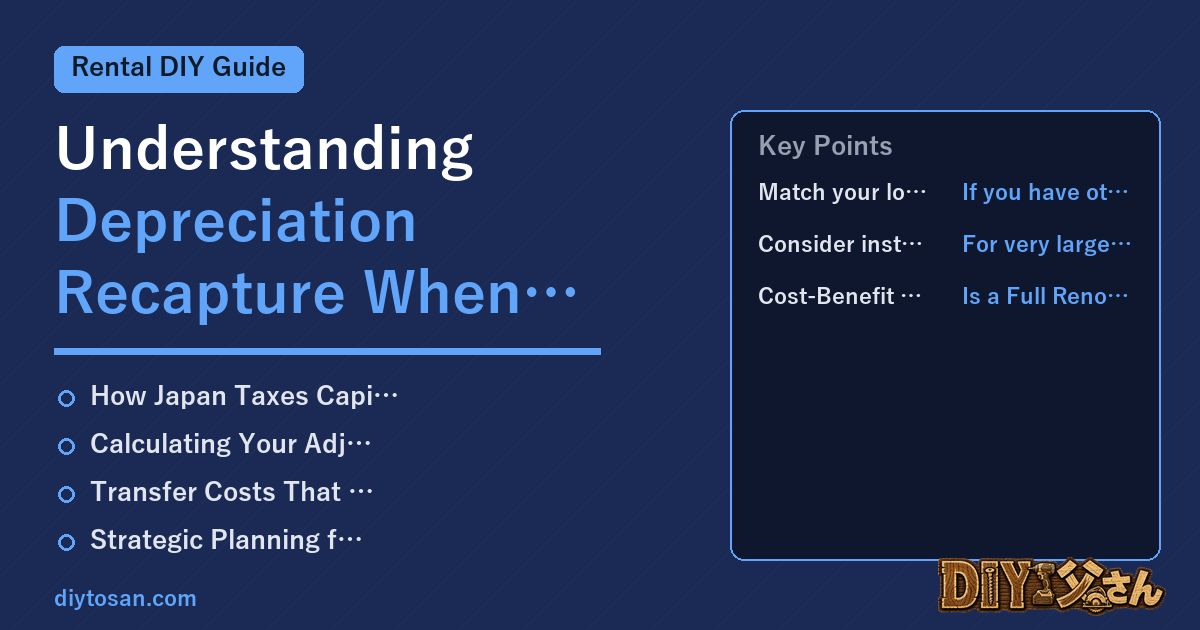
Understanding Depreciation Recapture When Selling Japanese Property
Depreciation is a powerful tool that reduces your taxable income every year you own a rental property. But there is a tax reckoning when you sell: the government “recaptures” the benefit of those deductions through capital gains tax on the sale. Many Japanese landlords are surprised by their tax bill at the time of sale because they did not understand this dynamic when they were claiming depreciation. Let me walk through how it works so you can plan accordingly.
How Japan Taxes Capital Gains on Real Property
ud83duded2 RECOMMENDED ON AMAZON US
Personal Finance & Real Estate Books
The financial mindset shift that made property investment possible on a salary.
When you sell real estate in Japan, the gain is calculated as: Sale price u2212 (Acquisition cost u2212 Accumulated depreciation) u2212 Transfer costs. The accumulated depreciation you have claimed over the years reduces your adjusted cost basis, which mathematically increases your taxable gain even if the property’s market value has not actually risen.
Japan taxes real estate capital gains differently based on the holding period. For properties held more than 5 years as of January 1 of the sale year, the long-term capital gains rate applies: 15% national income tax + 5% local inhabitant tax = 20.315% (including the reconstruction special income tax). For properties held 5 years or less, short-term gains are taxed at a combined rate of approximately 39.63%. The difference between long and short-term is significant u2014 roughly double the tax rate for short-term sales.
Calculating Your Adjusted Cost Basis
ud83duded2 RECOMMENDED ON AMAZON US
Budget Planners for Property Owners
Track every yen in and out u2014 the foundation of profitable landlord accounting.
Let me illustrate with a concrete example. You purchased a wood-frame apartment building 10 years ago for u00a520,000,000, allocated as u00a58,000,000 land and u00a512,000,000 building. The 22-year useful life gives a depreciation rate of 0.046. Annual depreciation = u00a512,000,000 u00d7 0.046 = u00a5552,000. Over 10 years: u00a55,520,000 in accumulated depreciation has been claimed.
Your adjusted cost basis at sale: u00a520,000,000 u2212 u00a55,520,000 = u00a514,480,000. If you sell the property for u00a522,000,000, your gain appears to be u00a522,000,000 u2212 u00a514,480,000 u2212 u00a5500,000 (transfer costs) = u00a57,020,000. At the long-term rate of 20.315%, your capital gains tax is approximately u00a51,426,000.
Without the depreciation claimed over 10 years, your gain would only have been u00a522,000,000 u2212 u00a520,000,000 u2212 u00a5500,000 = u00a51,500,000, and the tax would be about u00a5305,000. The difference u2014 u00a51,121,000 in extra tax u2014 is the “recapture” of the depreciation benefits you enjoyed annually. Importantly, you saved more in income tax over 10 years (u00a55,520,000 in deductions u00d7 your marginal rate) than you pay in recapture tax, so the math still favors claiming depreciation u2014 but you need to plan for the sale tax liability.
Transfer Costs That Reduce Your Taxable Gain
The transfer costs (u8b72u6e21u8cbbu7528) that can be deducted from your sale price include: real estate agent commission (typically 3% + u00a560,000 + consumption tax), stamp duty on the sale contract, legal fees for title transfer, demolition costs if you demolish a structure on the land, and costs directly incurred to facilitate the sale. These can amount to 3u20135% of the sale price and meaningfully reduce your taxable gain.
Note that renovation costs incurred specifically to prepare a property for sale may also qualify as transfer costs, but only if they were performed within a short period prior to the sale and clearly for the purpose of enhancing salability. Routine maintenance is not deductible as a transfer cost.
Strategic Planning for Tax-Efficient Property Sales
ud83duded2 RECOMMENDED PRODUCTS
Tax Guides for Property Investors
Knowing the tax rules turns a good investment into a great one.
Knowing how depreciation recapture works opens up several planning opportunities:
- Time your sale for long-term status: If you are close to the 5-year mark, waiting until January 1 of the sixth year from purchase can cut your capital gains rate from 39.63% to 20.315% u2014 a 19-percentage-point difference on potentially millions of yen. Check the NTA’s calculation u2014 it is based on years as of January 1 of the sale year, not the anniversary of purchase.
- Match your losses: If you have other capital losses from securities in the same year, you cannot offset them against real property gains (Japan does not allow cross-category loss netting between securities and real property). Plan accordingly.
- Consider installment sales: For very large gains, structuring the payment over multiple tax years can sometimes help with cash flow, though it does not reduce the total tax owed.
- 3,000u4e07u5186 special deduction: This deduction applies when you sell your primary residence, not a rental property. Do not assume it applies to investment property.
Selling a rental property is a complex transaction. Even seasoned landlords benefit from engaging a tax accountant at least six months before their planned sale date to model the tax impact and explore any applicable exemptions or timing strategies. The consultation fee is a minor expense relative to the potential tax savings from proper planning.
Renovation Cost Reduction Checklist (60% Savings Method)
My step-by-step process management template that cut renovation costs by 60% across 3 apartment buildings over 15 years.
ud83cudfe0 More from DIY Father
15 years of landlord experience u00b7 3 apartment buildings u00b7 DIY renovations that saved millions of yen. Browse all articles at diytosan.com