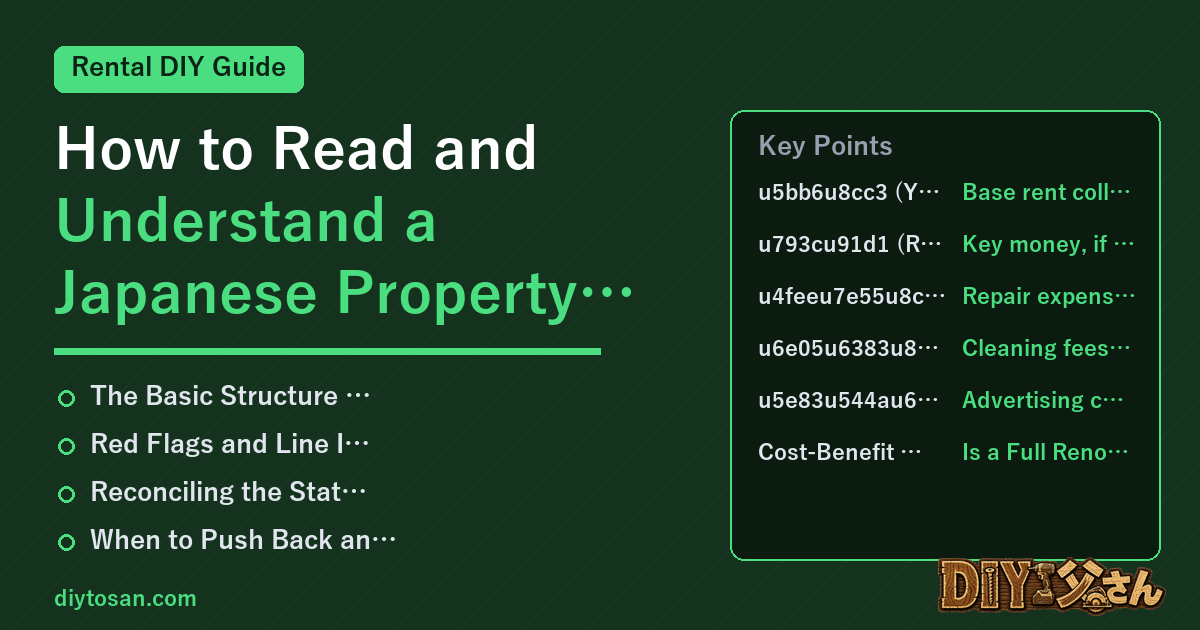
How to Read and Understand a Japanese Property Management Statement
If you use a property management company (u7ba1u7406u4f1au793e) in Japan, you receive a monthly statement showing income collected and expenses charged against your property. For landlords new to Japan or new to using a management company, these statements can be confusing u2014 especially since they are almost always in Japanese with formatting conventions that differ significantly from Western property management reports. This guide walks you through what every line item means and what to watch for.
The Basic Structure of a Japanese Management Statement
ud83duded2 RECOMMENDED ON AMAZON US
Personal Finance & Real Estate Books
The financial mindset shift that made property investment possible on a salary.
Japanese management statements (u7ba1u7406u5831u544au66f8, sometimes called u53ceu652fu5831u544au66f8 or u9001u91d1u8a08u7b97u66f8) typically follow a consistent structure. They show gross income collected at the top, deduct various expenses in the middle, and show the net remittance amount (u9001u91d1u984d) at the bottom u2014 the amount that will be wire-transferred to your account.
The top section u2014 Income (u53ceu5165u306eu90e8) u2014 lists:
- u5bb6u8cc3 (Yachin): Base rent collected from tenants
- u7ba1u7406u8cbb / u5171u76cau8cbb (Kanrihi / Kyoekihi): Common area fee collected from tenants (passed through to you or retained by the management company, depending on your agreement)
- u99d0u8ecau5834u6599 (Chushajoryo): Parking fees, if applicable
- u793cu91d1 (Reikin): Key money, if received from a new tenant this month
- u305du306eu4ed6u53ceu5165 (Sonota Shunyu): Other income such as penalty fees, storage fees
The middle section u2014 Expenses (u652fu51fau306eu90e8) u2014 lists:
- u7ba1u7406u59d4u8a17u8cbb (Kanri Itakuhi): Management fee charged by the management company (typically 5u201310% of rent)
- u4feeu7e55u8cbb (Shuzanhi): Repair expenses charged this month
- u6e05u6383u8cbb (Seisouhi): Cleaning fees for common areas
- u5e83u544au6599 (Kokokuryou): Advertising costs for vacant units
- u4ef2u4ecbu624bu6570u6599 (Chukai Tesuryo): Agency/referral fees for new tenants
- u5404u7a2eu7a0eu91d1u30fbu516cu5171u6599u91d1 (Kakushu Zekin / Koukyouryokin): Various taxes and utility bills paid on your behalf
Red Flags and Line Items to Scrutinize
ud83duded2 RECOMMENDED ON AMAZON US
Budget Planners for Property Owners
Track every yen in and out u2014 the foundation of profitable landlord accounting.
Most management statements are accurate, but errors do occur, and some management companies are more thorough than others in their billing practices. Line items that warrant a second look:
- Repair charges with no work order attached: Every repair charge should come with supporting documentation u2014 at minimum a brief description of what was repaired and why. If you see a u00a530,000 “u4feeu7e55u8cbb” with no explanation, request the work order and receipt before accepting it.
- Advertising fees for a unit that was not vacant: Occasionally, management companies charge ongoing advertising fees for units that are already occupied or for listings that should have been removed. Verify that advertising charges correspond to actual vacancies.
- Management fee calculated on gross including taxes: Confirm that the management fee percentage is applied to the net rent amount, not to the gross including consumption tax (u6d88u8cbbu7a0e), unless your contract specifies otherwise.
- Mystery deductions labeled u305du306eu4ed6 (Other): Any vague “other expense” over u00a55,000 deserves a detailed explanation. Request backup documentation.
Reconciling the Statement Against Your Expectations
Each month, before accepting the statement, do a quick reconciliation against your expectations. Start with the number of occupied units and their monthly rents u2014 you should know this independently. Calculate expected gross rent. Compare to the statement’s rent line. Any discrepancy needs explanation: partial month rent for a new tenant (u65e5u5272u308au8a08u7b97), rent reduction agreed with a tenant, or u2014 in rare cases u2014 an unreported vacancy.
For repair charges, compare against any repair requests you were notified of and approved. In Japan, management companies are typically required to get your approval before authorizing repairs above a threshold amount (usually u00a550,000u2013u00a5100,000) defined in your management contract. If a repair charge appears that you were not notified of, ask whether it fell under the emergency repair authorization clause and request documentation.
Keep every monthly statement permanently in both paper and digital format, organized by property and year. These statements are the primary documentation for the management fee, repair expense, and advertising cost deductions on your tax return. The NTA may request them in an audit, and having a complete, organized archive demonstrates diligence and supports your deductions fully.
When to Push Back and When to Switch Companies
ud83duded2 RECOMMENDED PRODUCTS
Tax Guides for Property Investors
Knowing the tax rules turns a good investment into a great one.
Most discrepancies on management statements are simple errors that a polite inquiry resolves quickly. But if you notice a pattern u2014 recurring unexplained charges, poor documentation, repairs you were not notified of u2014 it may be time to evaluate whether your management company is serving your interests well.
Switching management companies in Japan is procedurally straightforward, though it requires coordinating the transition of tenant contracts, security deposit records, and bank payment registrations. Do not stay with a management company out of inertia if their statements consistently require hours of your time to untangle. Your time is a cost too.
Renovation Cost Reduction Checklist (60% Savings Method)
My step-by-step process management template that cut renovation costs by 60% across 3 apartment buildings over 15 years.
ud83cudfe0 More from DIY Father
15 years of landlord experience u00b7 3 apartment buildings u00b7 DIY renovations that saved millions of yen. Browse all articles at diytosan.com