u2192 Back to all English articles
Hi there, I’m DIY Dad. ^ ^
This is the next chapter in my 1st-floor Japanese room (washitsu) renovation series. With the diatomite plaster walls turning out better than expected, it was time to tackle the discolored wood surfaces.
Tools and materials used: orbital sander, sandpaper.
The Problem u2014 Weathered, Discolored Wood
ud83duded2 RECOMMENDED PRODUCTS
Fusuma Replacement Paper Kits
Fusuma renewal is the fastest Japanese-room refresh u2014 paper, paste, and 2 hours.
The columns (pillars) and trim around the room had weathered to a deep, dark brown over the years. There were scratches too u2014 some shallow, some fairly deep. For someone who’d lived with those columns from day one, you might call it character. But my goal for this renovation was to get as close to brand-new as possible. The character can come back once my family starts living here. ^_-
Two Approaches to Discolored Wood
ud83duded2 AVAILABLE ON AMAZON JAPAN
Tatami Repair Materials (Amazon Japan)
Fresh tatami edges signal a well-maintained property u2014 tenants feel it immediately.
Option 1 u2014 Concealing the Discoloration
Cover it up with paint, oil stain, or a similar coating. Simple and fast, but you lose the natural wood grain underneath.
Option 2 u2014 Removing the Discoloration
Use a bleaching agent (aku-nuki stripper) or sand the surface down to fresh wood. More work, but it preserves the grain.
I wanted to keep the wood grain visible, so concealing was off the table. That meant removal. I also didn’t want to use chemicals, and since the discoloration looked purely surface-level with no deep staining, sanding seemed like the right call. ^ ^
Sanding With an Orbital Sander
I loaded sandpaper onto the orbital sander and went at the wood surfaces. The textbook approach is to start in an inconspicuous spot to test results first. I went straight for the middle of the most visible column instead. Looking back as I write this, I was full of momentum but not much caution. Somehow it worked out though. ^^;
My hunch was right u2014 the discoloration was only surface-deep. Here’s how it looked at each stage:
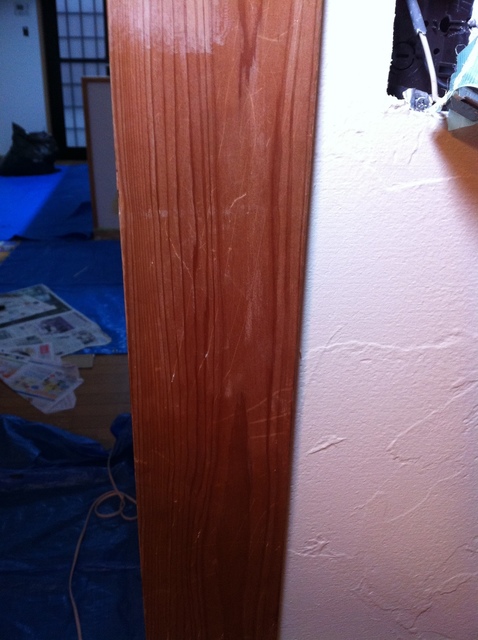
Before sanding.
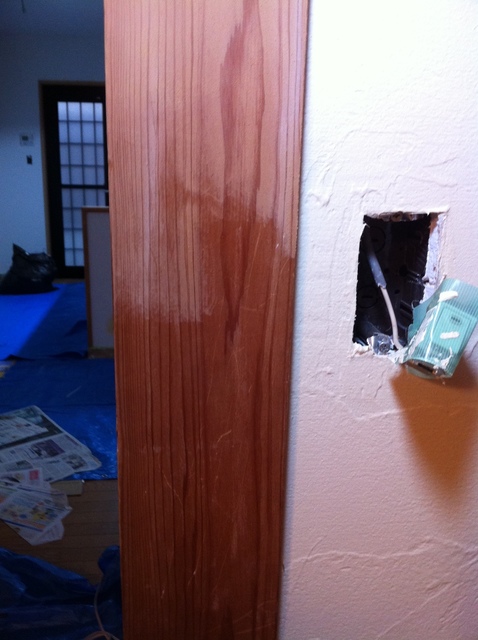
Mid-sanding, working from the top down. You can clearly see two colors u2014 the untouched dark wood and the fresh wood being revealed.
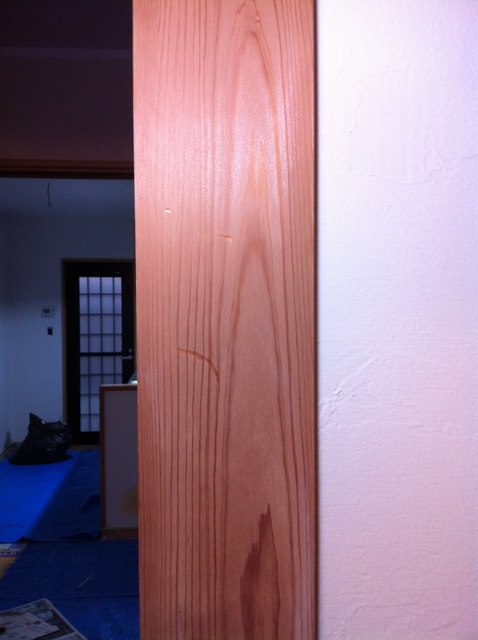
After sanding. The discoloration is completely gone and the natural wood color is back. A few deep scratches remain, but overall it looks like new. I was absolutely thrilled.
2026 Update u2014 Japanese Room Renovation: Planning Is 80% of the Work
ud83duded2 RECOMMENDED PRODUCTS
Shoji Screen Paper & Repair Kits
Replace shoji paper every 3u20135 years u2014 it yellows faster than any other surface.
Japanese room renovation has a different kind of difficulty compared to Western-style rooms. Elements like shinkabe (exposed-column walls), tatami (straw floor mats), shoji (paper-screen doors), and the kamoi/shikii (upper and lower door tracks) are unique to traditional Japanese rooms, and they caught me off guard at first.
Work Items for This Japanese Room
- Tatami mat resurfacing u2014 hired a professional
- Diatomite plaster wall finish u2014 DIY
- Wood surface cleaning on columns and trim u2014 DIY
- Shoji (paper screen) replacement u2014 DIY
- Air conditioner installation u2014 DIY
I hired out only the tatami work. You could technically do it yourself, but measuring, cutting, and sewing the border binding requires specialist skill u2014 outsourcing made far more sense cost-wise. ^ ^
About Shinkabe u2014 The Exposed-Column Wall Style
Shinkabe (literally “true wall”) is a traditional Japanese construction method where the structural columns are left exposed on the wall surface. Unlike the Western ookabe (“large wall”) style u2014 where columns are hidden inside the wall u2014 shinkabe means you have to carefully handle the junction between column and plaster. When applying diatomite plaster, masking the columns with tape before you start is essential; getting a clean edge at those junctions defines the final look.
Wood Surface Cleaning u2014 The Orbital Sander Is the Fastest Method
For removing discoloration from columns and trim, the orbital sander is unbeatable u2014 roughly ten times faster than sanding by hand, and the result is far more even. Start with 240-grit and finish with 400-grit for a smooth surface. For deep scratches, knock them down first with 120-grit before moving to finer grits.
Restoring a Japanese-style room by DIY is challenging, but the sense of accomplishment when you finish is something else entirely.
DIY Renovation Quote Review Manual
How to read, compare, and negotiate contractor quotes. This manual saved me u00a5800,000 on a single renovation project.
ud83cudfe0 More from DIY Father
15 years of landlord experience u00b7 3 apartment buildings u00b7 DIY renovations that saved millions of yen. Browse all articles at diytosan.com