Self-Managing vs. Using a Property Management Company in Japan
The first question many new Japanese landlords face is whether to handle management themselves or hand it off to a property management company (kanri gaisha). I’ve done both u2014 I used a management company for the first two years, switched to self-management, and eventually landed on a hybrid approach. Both models have genuine advantages and real costs. Here’s an honest comparison based on my actual experience.
What Property Management Companies Actually Do
ud83duded2 RECOMMENDED ON AMAZON US
Top Property Management Books
Build the knowledge base that separates professional landlords from amateur ones.
A property management company in Japan typically handles the following under a standard management contract (kanri keiyakusho):
- Tenant recruitment u2014 listing the property, showing it, screening applicants
- Lease execution and contract management
- Rent collection and remittance (typically monthly, minus their fee)
- First-response for tenant issues and maintenance requests during business hours
- Coordination of repairs with contractors (though the cost usually falls on the landlord)
- Move-out processing and deposit settlement
For this, management companies in Japan typically charge between 5% and 10% of monthly rent. Some also charge a setup fee (shokai tesuuryou) equivalent to one month’s rent for each new tenant they place, and may charge additional fees for move-out processing, inspection coordination, and advertising on portals like SUUMO.
The total cost of using a management company is therefore often 15-20% of annual rent when you factor in all fees u2014 not just the monthly percentage. For a unit renting at 80,000 yen per month, that’s 144,000 to 192,000 yen per year.
The Real Costs and Benefits of Self-Management
ud83duded2 RECOMMENDED PRODUCTS
Landlord-Tenant Law Guides
Know exactly what you can and cannot do u2014 essential reading before any dispute.
Self-management eliminates the management fee, but it doesn’t eliminate the underlying work u2014 it just means you’re doing it yourself. The honest accounting of self-management costs:
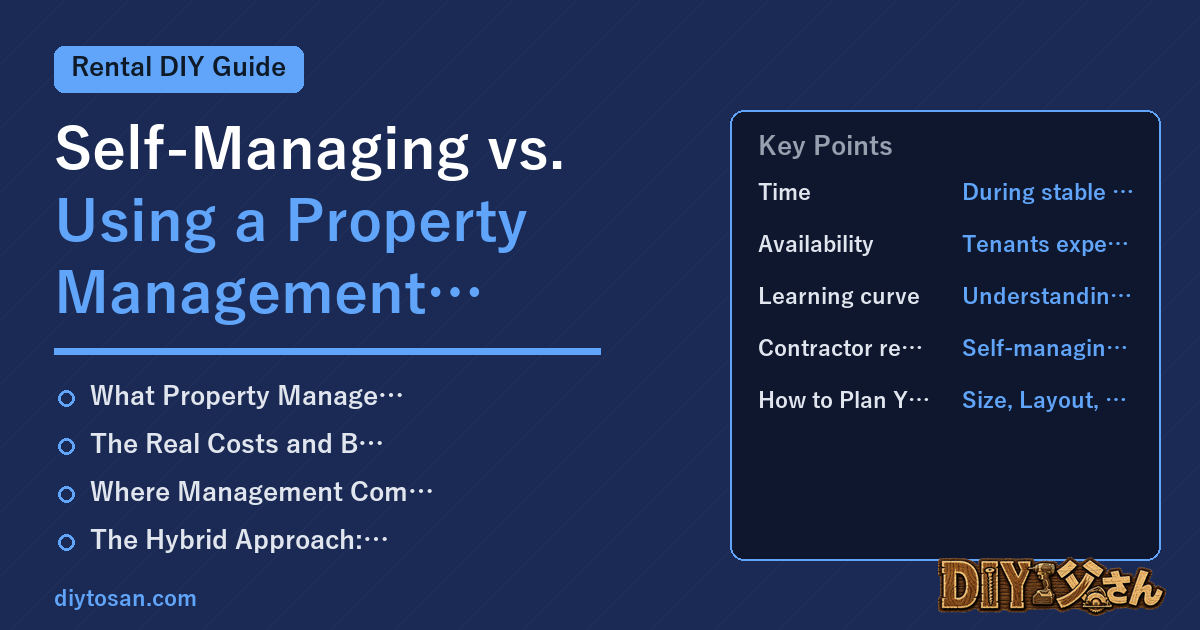
- Time: During stable tenancy periods, I spend perhaps two to three hours per month per property on administration, communication, and maintenance coordination. During vacancy and turnover periods, this rises to ten or more hours per week.
- Availability: Tenants expect responsive communication. If you have a demanding job or travel frequently, the availability requirement can be genuinely burdensome.
- Learning curve: Understanding Japanese rental law, the MLIT restoration guidelines, and proper lease documentation takes time and initial effort. Mistakes during this learning period can be expensive.
- Contractor relationships: Self-managing landlords need to develop their own network of reliable, fairly-priced contractors. This takes years to build and requires effort to maintain.
The benefits: keeping the management fee (significant over time), direct control over every aspect of the property, direct relationship with your tenants, and full visibility into the property’s condition and finances.
Where Management Companies Fall Short
My experience with property management companies in Japan revealed some consistent limitations. Smaller companies often have contractor relationships that aren’t in the landlord’s best interest u2014 they may use higher-cost contractors and take a referral fee, inflating repair costs without the landlord’s knowledge. They may also be less aggressive about vacancy marketing, preferring to let units sit rather than reduce rent or increase listing spend.
The move-out and deposit settlement process is another area of risk. Some management companies over-claim against tenant deposits, creating disputes that could have been avoided with fairer settlement practices. These disputes ultimately affect the landlord’s reputation, not the management company’s.
Tenant communication quality varies enormously between management companies. A company that handles a tenant’s repair request slowly, dismissively, or bureaucratically is damaging your asset u2014 a dissatisfied tenant leaves sooner, leaves the unit in worse condition, and doesn’t refer their friends.
The Hybrid Approach: What I Actually Do Now
ud83duded2 RECOMMENDED PRODUCTS
Property Inspection Forms & Checklists
Document everything. A signed checklist at move-in prevents every deposit dispute.
I currently self-manage most operations but use a real estate agent for tenant recruitment and initial lease execution. This means:
- The agent handles SUUMO listings, showing the property, applicant screening, and lease execution u2014 for which they receive the standard one-month introductory fee, paid by the tenant
- Once the tenant is in, I take over direct management u2014 communication, maintenance coordination, rent collection
- I handle inspections, renewals, and move-out processing myself
This hybrid captures most of the financial benefit of self-management while offloading the most time-intensive part of the process (recruitment) to professionals who have the listing platforms and market knowledge to execute it efficiently. For any landlord who finds recruitment and applicant screening overwhelming, this structure is worth seriously considering.
Property Management Company Evaluation u2014 12-Point Checklist
Developed after switching management companies twice. Saves you from costly mistakes that took me years to learn.
ud83cudfe0 More from DIY Father
15 years of landlord experience u00b7 3 apartment buildings u00b7 DIY renovations that saved millions of yen. Browse all articles at diytosan.com