Choosing the Right Location for a Rental Property in Japan
Japan is famously shrinking. The population peaked around 2008 and has been declining ever since. This demographic reality makes location the single most important factor in Japanese real estate investmentu2014even more so than in countries with growing populations. Get the location right and the property almost manages itself. Get it wrong and you’ll spend years trying to fill vacancies in a market that doesn’t want your units.
The Population Filter: Start Here
ud83duded2 RECOMMENDED ON AMAZON US
Real Estate Investment Books
The books that changed how I think about money, leverage, and long-term wealth.
Before I look at a single property detail, I check the population trajectory of the target city using data from the National Institute of Population and Social Security Research (u56fdu7acbu793eu4f1au4fddu969cu30fbu4ebau53e3u554fu984cu7814u7a76u6240). Their projections go out to 2045 and show which municipalities are expected to grow, stabilize, or shrink.
My personal rule: I will not buy in a municipality projected to lose more than 15% of its population by 2040. That eliminates vast swaths of rural Japan but still leaves plenty of viable markets.
The cities I focus on have one or more of these characteristics:
- Home to a national or private university with significant enrollment
- Regional administrative hub (prefectural capital or major city government)
- Industrial base with stable employment (automotive supply chain, logistics, manufacturing)
- Medical hubu2014large hospitals and medical schools generate a stable renter population
- Growing inbound tourism with associated hospitality employment
Walking Distance to Train Stations: The Gold Standard
ud83duded2 RECOMMENDED ON AMAZON US
Financial Calculators for Investors
Run yield and cash-flow calculations in seconds u2014 worth every yen on your first deal.
Japanese renters are famously train-dependent. A unit that is a 5-minute walk from a station commands a significant premium over one that is a 15-minute walku2014even if the 15-minute unit is otherwise identical. I’ve seen the same floor plan rent for 8,000 yen per month more simply because it was 3 minutes closer to the nearest station entrance.
Here’s what I’ve learned about the walk-time premium:
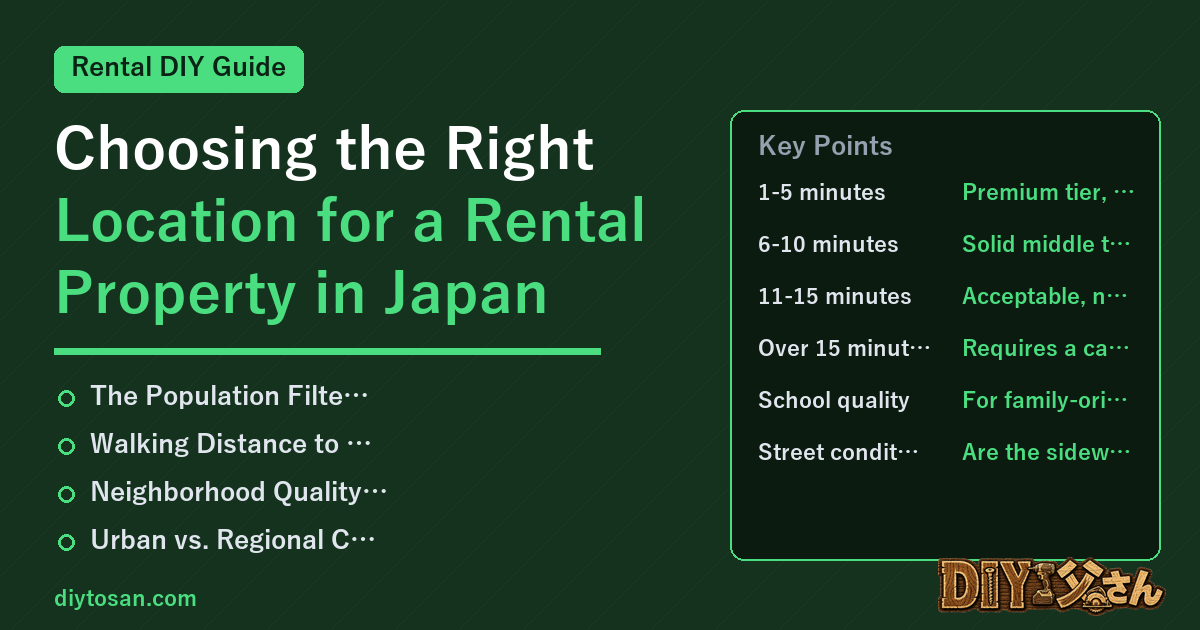
- 1-5 minutes: Premium tier, lowest vacancy rates
- 6-10 minutes: Solid middle tier, good demand
- 11-15 minutes: Acceptable, needs to compete on price or quality
- Over 15 minutes: Requires a caru2014you’re competing with suburban homebuyers, not renters
If I can’t walk comfortably to a station in under 12 minutes, I need a compelling reason to buy (unusually high yield, unique tenant base, plans for the area) to justify the risk.
Neighborhood Quality Indicators I Check on the Ground
Data tells part of the story. But I always visit a property in person before making an offer, and I walk the neighborhood at different times of day. Here’s my on-the-ground checklist:
- Convenience stores and supermarkets: A Family Mart or Lawson within 5 minutes is a positive signal. Convenience stores follow rooftopsu2014they have sophisticated location analytics.
- School quality: For family-oriented units, check school district reputation (u5730u57dfu306eu8a55u5224). You can find school-district maps at your local city hall.
- Street condition: Are the sidewalks maintained? Is there evidence of active businesses? Vacant shopfronts are a warning sign.
- Competing rental supply: Walk a 10-minute radius. How many “u7a7au5ba4u3042u308a” (vacancy available) signs do you see? A lot of vacancies suggests oversupply in the area.
- Crime and quiet: Check the local police precinct’s public crime statistics (u72afu7f6au767au751fu72b6u6cc1). Some municipalities publish this by neighborhood.
Urban vs. Regional Cities: My Honest Assessment
ud83duded2 RECOMMENDED PRODUCTS
Investment Analysis Templates
Spreadsheet analysis is the difference between a good deal and a disaster.
A lot of investors dream about Tokyo or Osaka properties, but the math rarely works for individual investors using leverage. A Tokyo condo priced at 50 million yen might yield only 4% surface (and 2.5% net), while a regional city apartment building priced at 15 million yen might yield 10% surface (and 6-7% net).
I invest in regional cities. My reasoning:
- Higher yields mean faster loan paydown and positive cash flow from day one
- Less competition from institutional investors and wealthy Tokyo buyers
- Easier to develop a local network of tradespeople and property managers
- Lower barrier to entry allows for more diversification across multiple properties
The tradeoff is that regional properties are harder to liquidate quickly if you need to sell. But I plan to hold for 20+ years, so liquidity is less important to me than annual cash flow and debt paydown.
Choose your location based on data, visit it in person, walk it thoroughly, and never let surface yield distract you from the fundamental question: will people actually want to live here, in five years and in ten?
Property Cash Flow Calculator + Complete Guide
The exact Excel spreadsheet I use for every property purchase decision u2014 5-year projection, yield calculation, and break-even analysis included.
ud83cudfe0 More from DIY Father
15 years of landlord experience u00b7 3 apartment buildings u00b7 DIY renovations that saved millions of yen. Browse all articles at diytosan.com