How I Bought My First Rental Property in Japan: A Step-by-Step Guide
I remember sitting across from the bank loan officer, sweating through my dress shirt, wondering if I was about to make the biggest mistake of my life. That was twelve years ago. Today I own four rental units and my tenants essentially pay my mortgage. If you’re thinking about buying your first rental property in Japan, let me walk you through exactly what I didu2014mistakes included.
Step 1: Getting Your Finances in Order Before You Shop
ud83duded2 RECOMMENDED ON AMAZON US
Real Estate Investment Books
The books that changed how I think about money, leverage, and long-term wealth.
Before I even looked at a single listing, I spent three months getting my financial house in order. Japanese banks are notoriously conservative lenders, especially for investment properties. Here’s what they scrutinize:
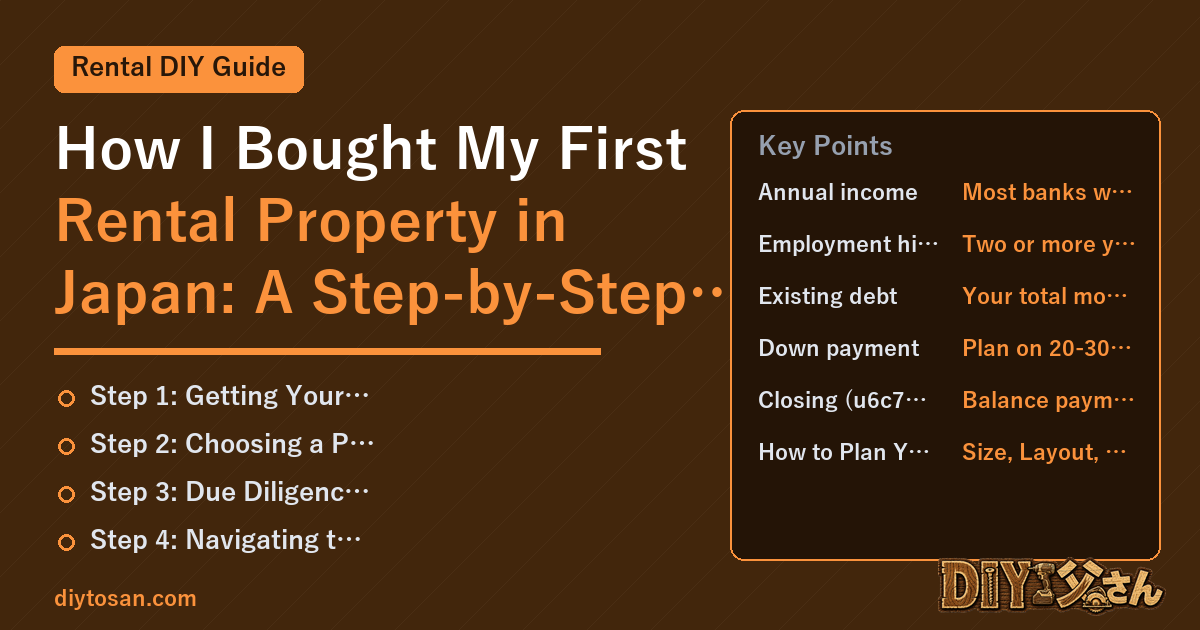
- Annual income: Most banks want to see at least 5 million yen per year before they’ll seriously consider you for an investment property loan. Some regional banks and credit unions (shinkin) are more flexible.
- Employment history: Two or more years at the same company is ideal. Self-employed buyers face additional hurdles and need three years of confirmed tax filings.
- Existing debt: Your total monthly debt payments (car loans, credit cards, other mortgages) should not exceed 35-40% of your monthly gross income.
- Down payment: Plan on 20-30% down for investment properties. Unlike owner-occupied homes, you rarely get 90% financing on rentals.
I had about 3 million yen saved and an annual salary of 6.5 million yen. That put me in a position to buy something in the 10-15 million yen range if I used leverage carefully.
Step 2: Choosing a Property Type and Location
ud83duded2 RECOMMENDED ON AMAZON US
Financial Calculators for Investors
Run yield and cash-flow calculations in seconds u2014 worth every yen on your first deal.
Japan’s rental market varies wildly by location. I made the deliberate choice to focus on a city with a population over 500,000u2014large enough to have steady rental demand, small enough that I wasn’t competing with institutional investors for every decent unit.
I settled on a used wood-frame apartment building (a small 4-unit property) rather than a single condo unit (u533au5206u30deu30f3u30b7u30e7u30f3). Here’s my reasoning: with a building, I control the exterior, the common areas, and my own maintenance schedule. With a condo, I’m at the mercy of the management association (u7ba1u7406u7d44u5408) and their decisions.
The property I eventually bought was a 1981-built wood-frame building in a mid-size city in the Chubu region. Purchase price: 12.8 million yen for four 2DK units.
Step 3: Due Diligenceu2014What to Check Before Making an Offer
This is where a lot of first-time buyers cut corners, and it’s where deals go wrong. For my first property, I hired a building inspector (u5efau7269u8a3au65adu58eb) for 80,000 yen. It was worth every yen. The inspection revealed:
- The roof needed replacement within 2-3 years (estimated cost: 600,000 yen)
- One unit had a bathroom fan that was venting into the wall cavity instead of outside
- Minor settlement cracks in the foundation that were cosmetic, not structural
I used the roof finding to negotiate the price down by 500,000 yen and got the seller to fix the bathroom fan before closing. Always get an inspection.
Beyond the physical condition, check the rent roll carefully. Ask for copies of all lease agreements. Verify that the rents stated in the listing are actually what tenants are payingu2014not inflated numbers from the original leases signed years ago.
Step 4: Navigating the Purchase Process
ud83duded2 RECOMMENDED PRODUCTS
Investment Analysis Templates
Spreadsheet analysis is the difference between a good deal and a disaster.
Japanese real estate transactions involve several professionals and fees that surprised me as a first-timer. Here’s the basic flow:
- Letter of intent (u8cb7u4ed8u8a3cu660eu66f8): Non-binding, but signals serious interest. You submit this before formal negotiations.
- Purchase agreement (u58f2u8cb7u5951u7d04): You pay a deposit (u624bu4ed8u91d1) at signing, typically 5-10% of the purchase price.
- Important matters explanation (u91cdu8981u4e8bu9805u8aacu660e): A licensed real estate agent must walk you through this document before you sign. Read it carefullyu2014it discloses legal restrictions on the property.
- Closing (u6c7au6e08): Balance payment, title transfer, loan execution all happen on the same day.
Transaction costs in Japan are substantialu2014budget about 7-10% of the purchase price. This includes the real estate agent commission (3% + 60,000 yen + tax on each side), registration taxes, stamp duties, and judicial scrivener (u53f8u6cd5u66f8u58eb) fees.
What I’d Do Differently
I’d start with a smaller propertyu2014a single unit rather than a four-unit buildingu2014just to learn the systems before scaling. Managing four units simultaneously while learning landlord law, tax filing requirements, and repair protocols was overwhelming in year one. But I survived, and more importantly, I learned. My first property is now fully paid down and generates about 580,000 yen per year in net cash flow. The journey is worth it.
Property Cash Flow Calculator + Complete Guide
The exact Excel spreadsheet I use for every property purchase decision u2014 5-year projection, yield calculation, and break-even analysis included.
ud83cudfe0 More from DIY Father
15 years of landlord experience u00b7 3 apartment buildings u00b7 DIY renovations that saved millions of yen. Browse all articles at diytosan.com