How Depreciation Works for Rental Properties in Japan (Tax Benefits Explained)
When I filed my first tax return as a landlord, I was shocked to discover that I owed almost no income tax on my rental profitsu2014even though I had positive cash flow. The reason was depreciation. Understanding how depreciation works in Japan is one of the most powerful things you can learn as a real estate investor. I’ll explain it in plain terms, with real numbers.
What Depreciation Is (and Why Japan’s Rules Are Investor-Friendly)
ud83duded2 RECOMMENDED ON AMAZON US
Real Estate Investment Books
The books that changed how I think about money, leverage, and long-term wealth.
The Japanese tax system recognizes that buildings wear out over time. To account for this, you’re allowed to deduct a portion of the building’s value each year as a “depreciation expense” (u6e1bu4fa1u511fu5374u8cbb) on your tax return. This is a non-cash deductionu2014you don’t spend the money, but it reduces your taxable income.
The amount you can deduct each year depends on the building’s legal useful life (u6cd5u5b9au8010u7528u5e74u6570) and the calculation method. Japan uses the straight-line method (u5b9au984du6cd5) for buildings, which means equal deductions every year over the useful life.
Legal useful lives by construction type:
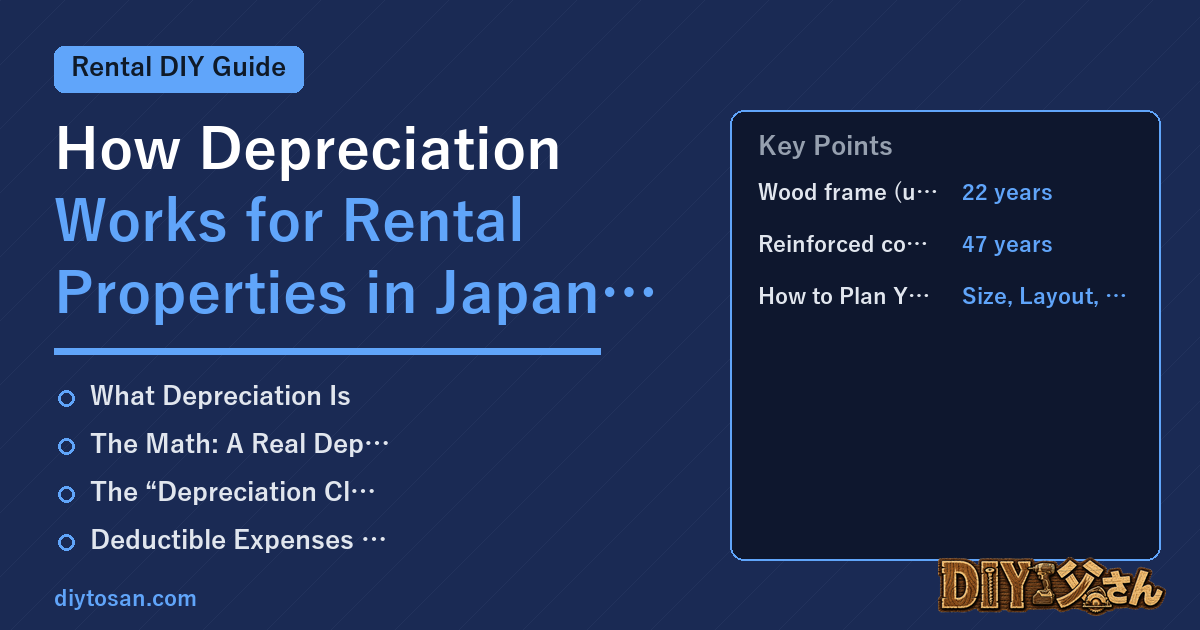
- Wood frame (u6728u9020): 22 years
- Light steel frame, thin-gauge (u8efdu91cfu9244u9aa8): 19 years
- Heavy steel frame (u91cdu91cfu9244u9aa8): 34 years
- Reinforced concrete (RC): 47 years
The straight-line depreciation rate for each type: wood = 0.046/year, RC = 0.022/year.
The Math: A Real Depreciation Example
ud83duded2 RECOMMENDED ON AMAZON US
Financial Calculators for Investors
Run yield and cash-flow calculations in seconds u2014 worth every yen on your first deal.
I bought a wood-frame apartment building in 2018 for 12 million yen. The land was appraised at 4 million yen and the building at 8 million yen. (Land is not depreciableu2014only the building portion counts.)
The building was built in 1992, making it 26 years old at purchase. It had already exceeded its 22-year legal useful life. For used buildings past their useful life, Japan has a special rule:
Remaining useful life = Legal useful life u00d7 20% (minimum 2 years)
For my wood-frame building: 22 years u00d7 20% = 4.4 years, rounded to 4 years. This means I can depreciate the entire 8 million yen building value over just 4 years.
Annual depreciation: 8,000,000 u00f7 4 = 2,000,000 yen per year.
Now here’s where it gets powerful. My annual net rental income (before depreciation) was about 1,600,000 yen. After subtracting 2,000,000 yen in depreciation, my taxable rental income was negative 400,000 yen. That loss could be used to offset my salary income, reducing my overall tax bill.
The “Depreciation Cliff” and What Happens After
The tax benefits of rapid depreciation on an old wood-frame building are significantu2014but they’re temporary. After year 4 in my example, the depreciation deduction disappears. My taxable rental income jumps from near-zero to the full 1,600,000 yen per year.
This is called the “depreciation cliff” (u511fu5374u5207u308c), and investors need to plan for it. Your options:
- Sell the property before the depreciation runs out (and buy something new with fresh depreciation)
- Accept the higher tax burden and continue holding for the long-term cash flow
- Reinvest profits into renovation work, which creates new depreciable assets
I chose to hold. Even after the depreciation cliff, the property generates strong cash flow that exceeds the additional tax cost. But I did use the high-depreciation years to aggressively pay down the loan, so my interest expense (also deductible) was maximized early on.
Deductible Expenses Beyond Depreciation
ud83duded2 RECOMMENDED PRODUCTS
Investment Analysis Templates
Spreadsheet analysis is the difference between a good deal and a disaster.
Depreciation gets the most attention, but Japan allows rental property owners to deduct many other legitimate expenses:
- Loan interest (not principalu2014only interest is deductible)
- Property management fees
- Fixed asset tax (u56fau5b9au8cc7u7523u7a0e)
- Building insurance premiums
- Repair and maintenance costs
- Advertising and tenant-finding fees
- Travel costs to visit and inspect your properties
- Professional fees (accountant, judicial scrivener)
- Utility costs for common areas
Keep meticulous records of all these expenses. I use a simple spreadsheet and scan all receipts. If the NTA (u56fdu7a0eu5e81) ever audits you, your documentation is your defense.
I strongly recommend working with a tax accountant (u7a0eu7406u58eb) who specializes in real estate for at least your first two years as a landlord. The costu2014typically 50,000-100,000 yen per year for a simple rental portfoliou2014pays for itself many times over in tax savings and avoided mistakes.
Property Cash Flow Calculator + Complete Guide
The exact Excel spreadsheet I use for every property purchase decision u2014 5-year projection, yield calculation, and break-even analysis included.
ud83cudfe0 More from DIY Father
15 years of landlord experience u00b7 3 apartment buildings u00b7 DIY renovations that saved millions of yen. Browse all articles at diytosan.com