DIY vs. Contractor: When the Cost Savings Actually Make Sense
I am a landlord who does a significant amount of his own repair and renovation work. But I am also a pragmatist. The question is never “can I do this myself?” u2014 with enough time and YouTube videos, almost anyone can learn almost anything. The real question is whether it makes financial and practical sense to do so, given the full picture of costs, risks, and your time value. Here is the framework I use to make that call.
Quantifying the True Cost of DIY
ud83duded2 RECOMMENDED ON AMAZON US
Personal Finance & Real Estate Books
The financial mindset shift that made property investment possible on a salary.
The rookie mistake in DIY cost analysis is comparing only material costs against a contractor’s total quote. That comparison ignores the full picture. The true cost of doing something yourself includes:
- Material costs (often similar to what a contractor pays, since you lack trade discounts)
- Tool acquisition or rental costs (a tile saw, a floor nailer, a pressure washer)
- Your time u2014 and this is frequently undervalued
- The learning curve cost (mistakes, redo work, wasted materials)
- The cost of delayed completion (lost rent during a longer vacancy)
Let me make this concrete. Replacing vinyl flooring in a 25 mu00b2 apartment: a contractor quotes u00a5125,000 all-in. Materials for DIY would cost roughly u00a575,000 (flooring, adhesive, transition strips, disposal). The job takes a professional crew half a day. It would take you, as a first-timer, 2u20133 full days including the learning curve. If your time is worth u00a53,000/hour (a conservative number for a working adult), that is 20 hours u00d7 u00a53,000 = u00a560,000 of time cost. Add u00a575,000 materials = u00a5135,000 u2014 more than the contractor quote. But if you are doing this for the third time on a familiar floor type, your time drops to 8u201310 hours, and the math flips: u00a575,000 + u00a527,000 = u00a5102,000 vs. u00a5125,000 contractor. The savings become real.
Tasks Where DIY Savings Are Consistently Worthwhile
ud83duded2 RECOMMENDED ON AMAZON US
Budget Planners for Property Owners
Track every yen in and out u2014 the foundation of profitable landlord accounting.
Through experience, I have identified categories where DIY reliably makes financial sense once you have learned the skill:
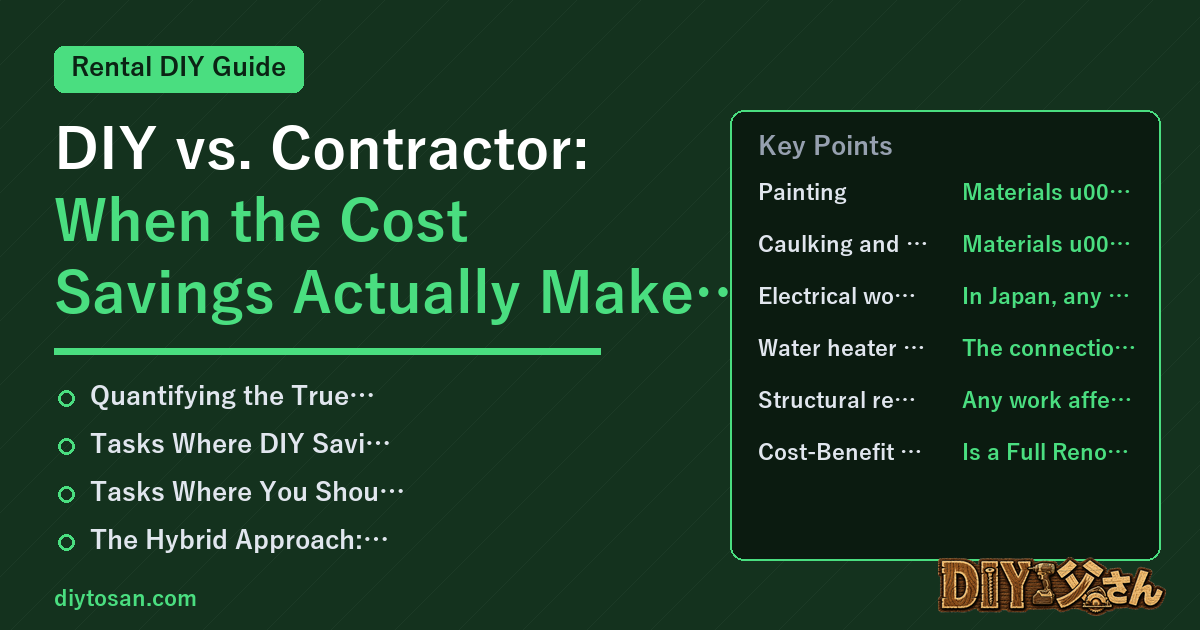
- Wallpaper replacement (u30afu30edu30b9u8cbcu308a): Material cost u00a520,000u2013u00a540,000 for a 1K unit vs. contractor quote of u00a580,000u2013u00a5120,000. The labor savings of u00a560,000u2013u00a580,000 per vacancy quickly justify the time investment in learning the skill.
- Painting: Materials u00a510,000u2013u00a525,000, contractor u00a550,000u2013u00a580,000. Painting is forgiving and teachable.
- Caulking and sealing: Materials u00a52,000u2013u00a55,000, contractor u00a515,000u2013u00a530,000. One of the highest ROI skills in any landlord’s toolkit.
- Door hardware and lock replacement: Parts u00a55,000u2013u00a515,000, contractor u00a520,000u2013u00a540,000. Straightforward with basic tools.
- Minor plumbing repairs (washer replacement, faucet aerator, showerhead): Parts under u00a55,000, contractor call-out fee u00a510,000u2013u00a520,000 before labor. Compelling savings.
- Cleaning (u9ad8u5727u6d17u6d44, u30a8u30a2u30b3u30f3u30afu30eau30fcu30cbu30f3u30b0): Renting a pressure washer or buying an AC cleaning kit saves significant money if you have multiple units to service.
Tasks Where You Should Always Hire a Licensed Professional
Not everything is a candidate for DIY. Japan has specific licensing requirements for certain trades, and performing unlicensed work creates liability risks and may void your insurance:
- Electrical work: In Japan, any work on fixed wiring u2014 beyond swapping outlet covers or light fixture connections u2014 requires a licensed electrician (u7b2cu4e8cu7a2eu96fbu6c17u5de5u4e8bu58eb at minimum). Unlicensed electrical work is illegal and creates fire and liability risks.
- Gas appliance installation and connection: Must be performed by a licensed gas engineer (u30acu30b9u5de5u4e8bu58eb). Non-compliance risks carbon monoxide incidents and insurance voidance.
- Water heater replacement: The connection to gas lines requires licensing. You can source the unit yourself to save on markup, but the installation must be professional.
- Structural repairs: Any work affecting load-bearing elements u2014 beams, columns, foundations u2014 requires a licensed contractor and potentially building permit involvement.
- Roof replacement (not patching): The liability exposure from a failed roof far exceeds any DIY savings.
The Hybrid Approach: How I Actually Work
ud83duded2 RECOMMENDED PRODUCTS
Tax Guides for Property Investors
Knowing the tax rules turns a good investment into a great one.
My actual approach combines DIY and professional contractors strategically. I hire licensed professionals for anything involving gas, electrical, or structural work u2014 full stop, no exceptions. For everything else, I evaluate case by case based on: my existing skill level with the task, the time available before the unit needs to be re-leased, and the cost differential.
For large renovation projects, I often act as my own general contractor: I coordinate and schedule multiple specialists, handle all the preparation and cleanup work myself, and do the finishing work (caulking, touch-up painting, hardware installation) myself after the specialists leave. This hybrid approach typically saves 20u201335% compared to hiring a single contractor for the full job, while keeping all licensed work in professional hands. It requires good organizational skills and comfort with Japanese contractor communication, but the savings on a full unit renovation u2014 typically u00a560,000u2013u00a5120,000 per project u2014 are well worth the effort.
Renovation Cost Reduction Checklist (60% Savings Method)
My step-by-step process management template that cut renovation costs by 60% across 3 apartment buildings over 15 years.
ud83cudfe0 More from DIY Father
15 years of landlord experience u00b7 3 apartment buildings u00b7 DIY renovations that saved millions of yen. Browse all articles at diytosan.com
💡 DIY工具・建材はヤフーショッピングで
DIYに必要な工具・建材はヤフーショッピングで。送料無料商品多数。