Property Tax (u56fau5b9au8cc7u7523u7a0e) in Japan: What Landlords Pay and When
Property tax u2014 officially u56fau5b9au8cc7u7523u7a0e (koteishisanzei) u2014 is one of the most predictable and significant annual expenses for Japanese landlords. Unlike repair costs that can surprise you, property tax arrives on a known schedule with a clear notice. Understanding how it is calculated, when it is due, and how it factors into your financial planning is essential for managing a rental portfolio effectively.
What Property Tax Covers and Who Pays It
ud83duded2 RECOMMENDED ON AMAZON US
Personal Finance & Real Estate Books
The financial mindset shift that made property investment possible on a salary.
In Japan, property tax is assessed by local municipalities (u5e02u533au753au6751) on land and buildings as of January 1 each year. The tax is paid by whoever owns the property on January 1, regardless of when during the year they acquired or sold it. This matters in real estate transactions u2014 when you buy a property, it is common practice to prorate the year’s property tax in the purchase settlement, with the buyer reimbursing the seller for the portion of the year after the transaction date.
Two separate taxes are usually billed together and commonly grouped under the “property tax” umbrella:
- u56fau5b9au8cc7u7523u7a0e (Fixed Asset Tax): Standard rate is 1.4% of assessed value (u56fau5b9au8cc7u7523u7a0eu8a55u4fa1u984d), though municipalities can set rates up to 2.1%.
- u90fdu5e02u8a08u753bu7a0e (City Planning Tax): Applies only to land and buildings in urban planning areas (u5e02u8857u5316u533au57df). Standard rate is 0.3% of assessed value, capped at 0.3% by law.
Total effective rate for most urban properties: approximately 1.7% of assessed value per year.
Understanding the Assessed Value
ud83duded2 RECOMMENDED ON AMAZON US
Budget Planners for Property Owners
Track every yen in and out u2014 the foundation of profitable landlord accounting.
The assessed value (u56fau5b9au8cc7u7523u7a0eu8a55u4fa1u984d) used for property tax calculation is not the market value of your property. It is set by the municipality every three years (next reassessment cycle after 2024 values: 2027) and is typically 60u201370% of the estimated market value for land and 50u201370% for buildings, though these ratios vary significantly by location and property type.
Your annual property tax notice (u8ab2u7a0eu901au77e5u66f8) will show the assessed values for land and building separately, along with the calculated tax for each. Review this notice carefully u2014 errors in assessed values do occur, and you have a window (typically until the end of June) to request a review (u5be9u67fbu7533u51fa) if you believe the assessment is inaccurate.
For residential land under 200 mu00b2, Japan provides a significant tax reduction: the fixed asset tax on the land portion is reduced to 1/6 of the standard calculation (called the u4f4fu5b85u7528u5730u7279u4f8b). For land between 200 mu00b2 and the total residential lot area, the reduction is 1/3. This reduction is automatically applied when the land is used for residential purposes and should appear on your tax notice.
Payment Schedule and Amounts
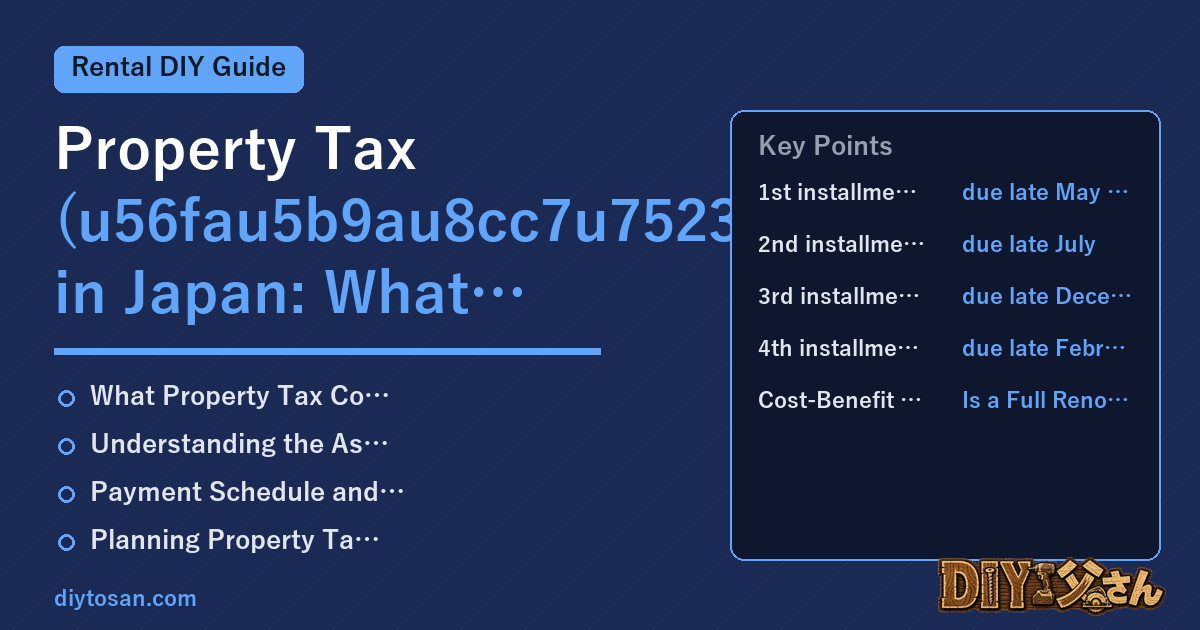
Property tax is billed annually but can be paid in four installments. The payment schedule varies slightly by municipality, but a typical schedule:
- 1st installment: due late May (with the annual notice)
- 2nd installment: due late July
- 3rd installment: due late December
- 4th installment: due late February of the following year
You can also pay the full year’s amount at once when the notice arrives in May, which some municipalities encourage with a small discount. Bank auto-payment (u53e3u5ea7u632fu66ff) is available in most municipalities and recommended u2014 it is easy to forget a mid-year installment.
For a concrete example of what property tax looks like in practice: a 25-unit apartment building in a mid-sized Japanese city, land area 300 mu00b2, building assessed at u00a515,000,000. Land assessed value: u00a512,000,000. After small lot reduction on 200 mu00b2 (1/6 reduction): effective land tax base = (200 mu00b2 portion u00d7 1/6) + (100 mu00b2 portion u00d7 1/3) of proportional assessed value. Simplified calculation: effective total annual tax approximately u00a5280,000u2013u00a5350,000 per year. This amount is fully deductible against rental income.
Planning Property Tax into Your Annual Budget
ud83duded2 RECOMMENDED PRODUCTS
Tax Guides for Property Investors
Knowing the tax rules turns a good investment into a great one.
Property tax is one of the easiest expenses to budget for because it is entirely predictable: the amount changes only every three years at reassessment, and even then the change is modest in most cases. My practice: when I receive the annual notice in May, I immediately enter the year’s total into my expense spreadsheet. I set calendar reminders for the 2nd, 3rd, and 4th installments so they never sneak up on me.
For landlords who manage multiple properties in multiple municipalities, the notices may arrive at slightly different times and on slightly different schedules. Create a simple annual calendar noting each property’s municipality, approximate notice date, and installment due dates. This five-minute exercise prevents late payments, which carry a penalty interest of approximately 14.6% per year under Japan’s delinquency rules (u5ef6u6edeu91d1) u2014 an expensive mistake for a completely predictable expense.
Renovation Cost Reduction Checklist (60% Savings Method)
My step-by-step process management template that cut renovation costs by 60% across 3 apartment buildings over 15 years.
ud83cudfe0 More from DIY Father
15 years of landlord experience u00b7 3 apartment buildings u00b7 DIY renovations that saved millions of yen. Browse all articles at diytosan.com