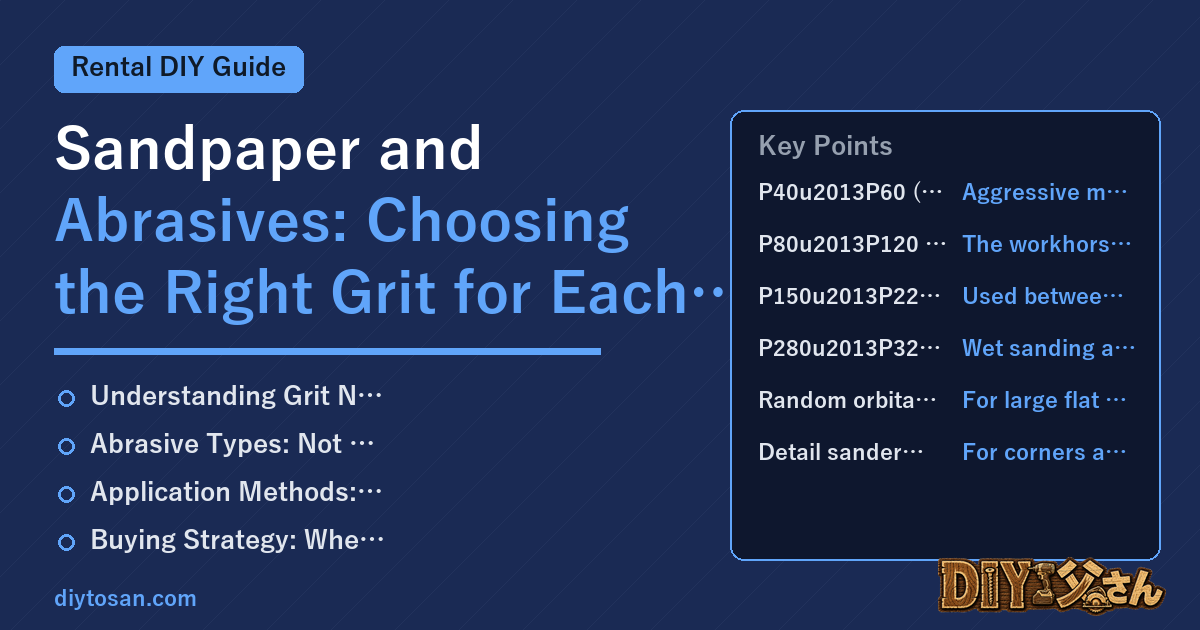
Sandpaper and Abrasives: Choosing the Right Grit for Each Job
Sandpaper is one of those tool-adjacent purchases that landlords consistently get wrong u2014 either buying the wrong grit for the job, or buying cheap abrasives that clog and tear before the work is done. I go through a significant quantity of abrasives across my properties, and understanding the differences has saved me real money and improved my finish quality. This guide covers everything a landlord needs to know about abrasives.
Understanding Grit Numbers: The Basics
ud83duded2 RECOMMENDED PRODUCTS
18V Professional Impact Driver
My most-used tool. If you own one power tool, make it this.
Grit numbers describe abrasive particle size u2014 lower numbers are coarser (remove more material, leave deeper scratches), higher numbers are finer (remove less material, leave smoother surfaces). For property maintenance work, you’ll work across a range from about P40 (very coarse) to P320 (fine).
- P40u2013P60 (coarse): Aggressive material removal. Use for stripping old paint, leveling rough wood surfaces, removing heavy rust, and shaping materials. Leaves deep scratches that need to be removed with finer grits. Not a finishing grit u2014 always follow with finer paper.
- P80u2013P120 (medium): The workhorses of rental property maintenance sanding. P80 removes the scratches left by P40/P60 and prepares surfaces for finer grits. P120 is a good final grit before primer on bare wood. Most landlord sanding tasks start and end in this range.
- P150u2013P220 (fine): Used between paint coats (typically P180u2013P220) to knock down dust nibs and surface imperfections. Also the finishing grit for bare wood before staining or a clear finish. P220 leaves a surface smooth enough to paint directly.
- P280u2013P320 (very fine): Wet sanding and final finishing. Used for smoothing final paint coats and finishing clear lacquer or varnish. Rarely needed for basic landlord maintenance tasks.
Abrasive Types: Not All Sandpaper Is the Same
ud83duded2 RECOMMENDED PRODUCTS
Power Tool Combo Kit (18V)
Combo kits are always better value than individual tools u2014 one battery charges all.
The mineral used to make sandpaper affects its performance and appropriate applications. In Japan, you’ll encounter several types.
- Aluminum oxide (u30a2u30ebu30dfu30ca / u9178u5316u30a2u30ebu30dfu30cbu30a6u30e0): The most common type and the correct choice for most wood sanding tasks. Aluminum oxide fractures under pressure to continuously expose fresh cutting edges u2014 this “self-sharpening” property extends sheet life significantly. Most of the sandpaper at Cainz and Konan is aluminum oxide.
- Silicon carbide (u70adu5316u30b1u30a4u7d20): Harder and sharper than aluminum oxide. Used for sanding between coats of paint or varnish (wet or dry), sanding metal, and for harder materials where aluminum oxide dulls too quickly. The black or dark gray paper you see in fine grits is usually silicon carbide.
- Ceramic abrasive (u30bbu30e9u30dfu30c3u30af): The highest performance and most expensive type. Used in professional automotive refinishing and high-production woodworking. Overkill for most landlord applications, but worth using in a random orbital sander for extended bare wood sanding sessions u2014 the sheets last significantly longer than aluminum oxide.
- Sanding sponge (u30b9u30ddu30f3u30b8u3084u3059u308a): Useful for contoured surfaces u2014 curved moldings, door profiles, and irregular shapes where flat sandpaper can’t conform. Not efficient for flat surfaces. MonotaRO carries 3M Scotch-Brite sanding sponges in various grits.
Application Methods: Orbital Sander vs. Hand Sanding
- Random orbital sander: For large flat surfaces u2014 floors, walls, furniture u2014 the random orbital motion prevents swirl marks that straight-line sanders create. Use 125mm discs (Makita and Hikoki random orbital sanders both use this size). For wall sanding before painting, start with P80u2013P120 to knock down texture and imperfections, finish with P180 before primer. A 50-disc pack of aluminum oxide 125mm discs from MonotaRO (P80 through P220) runs about u00a52,000u2013u00a53,000 u2014 stock up.
- Detail sander (triangular): For corners and tight areas. Same disc types, but triangular pad requires matching triangular sheets. The Makita BO4565 uses standard sheets cut to shape, while some models use proprietary hook-and-loop triangular sheets.
- Hand sanding: Still necessary for final finishing, curved surfaces, and areas where power sanders won’t fit. A sanding block (around u00a5300u2013u00a5600 at home centers) holds the paper flat and distributes pressure evenly u2014 always use one for flat surfaces rather than sandpaper alone, which conforms too much to low spots.
Buying Strategy: Where and What
ud83duded2 RECOMMENDED PRODUCTS
Tool Storage & Workshop Organizer
A well-organized toolbox saves 20 minutes on every job. Multiply that by 100 repairs.
Sandpaper is a genuine area where quality matters and where buying from MonotaRO saves significant money.
- Home center sandpaper is fine for occasional use but tends to clog faster than professional-grade abrasives. For frequent use, the 3M Pro Grade Precision series (available at MonotaRO) lasts 30u201350% longer than standard sheets.
- Buy in multi-packs rather than individual sheets. A 50-sheet assortment covering P80, P120, P180, and P220 from MonotaRO typically costs u00a51,500u2013u00a52,500 u2014 far cheaper per sheet than home center singles.
- Match the abrasive to the sander. Random orbital sanders use hook-and-loop discs; using adhesive-back discs on a hook-and-loop pad (or vice versa) either doesn’t work or requires adapter pads. Double-check disc type before ordering.
- Store sandpaper flat in a dry location. Paper-backed sandpaper absorbs humidity and becomes soft, which reduces cutting efficiency and causes it to tear during use.
The grit progression rule: never skip more than one grit step when working through grits. Going from P40 directly to P180 leaves P40 scratches that the P180 can’t remove efficiently. The sequence P40 u2192 P80 u2192 P120 u2192 P180 is the standard progression for most landlord surface preparation tasks.
ud83cudfe0 More from DIY Father
15 years of landlord experience u00b7 3 apartment buildings u00b7 DIY renovations that saved millions of yen. Browse all articles at diytosan.com