Safety Gear for DIY Property Repairs: Don’t Skip These
I’ll be direct: safety gear is the least glamorous part of any tool kit, and it’s consistently the most ignored. I’ve talked to landlords who own u00a550,000 in power tools but work without eye protection or dust masks. One wood chip at the wrong angle, one day breathing wallboard dust, and you’ll wish you hadn’t skimped. Here’s the complete safety kit for landlord DIY work in Japan, and why each item earns its place in your bag.
Eye and Face Protection
ud83duded2 RECOMMENDED PRODUCTS
18V Professional Impact Driver
My most-used tool. If you own one power tool, make it this.
Eye injuries are the most common DIY accident and among the easiest to prevent. The problem is that most cheap safety glasses are uncomfortable, fog immediately, and end up hanging around your neck instead of on your face.
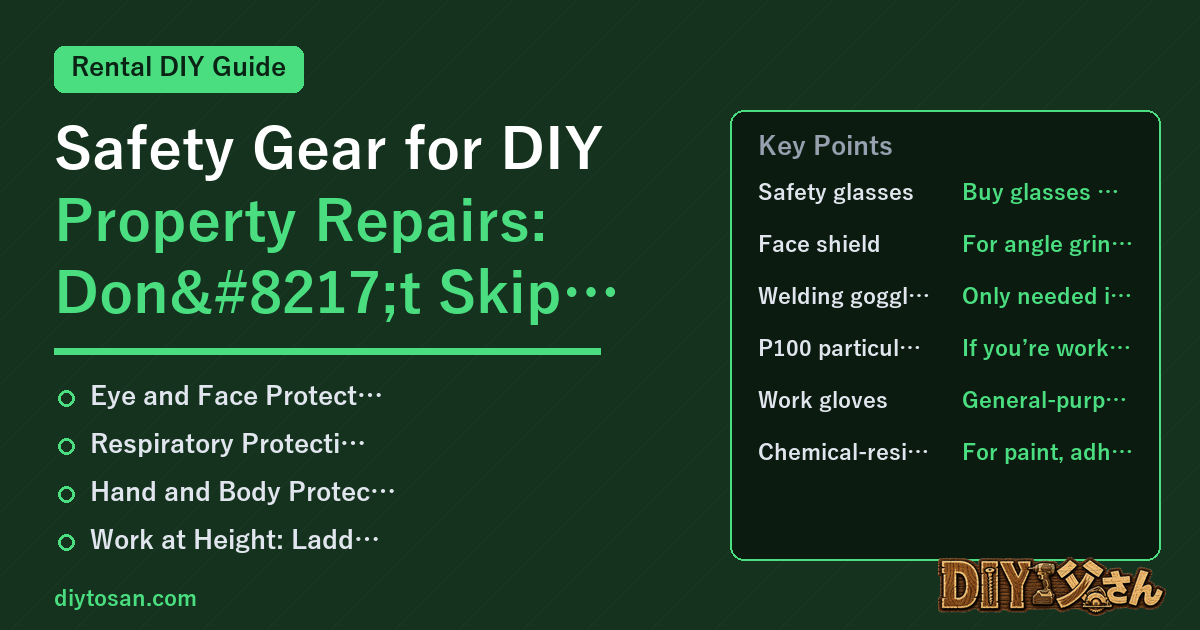
- Safety glasses: Buy glasses with side shields and anti-fog coating. The 3M Virtua (around u00a5800u2013u00a51,200 at MonotaRO) is the standard recommendation u2014 lightweight, clear optics, and comfortable enough to actually wear for an entire day of work. Keep a spare pair in your tool bag so you never have an excuse to work without them.
- Face shield: For angle grinder work, cutting tile, and working with chemicals, safety glasses aren’t enough. A full face shield (around u00a52,000u2013u00a53,500 at Cainz) protects against chips, sparks, and splash. The combination of safety glasses underneath and a face shield on top is the professional standard for grinding and cutting work.
- Welding goggles: Only needed if you ever do any brazing or work near reflective spark sources. Skip this unless your properties involve metal fabrication.
Respiratory Protection: More Important Than You Think
ud83duded2 RECOMMENDED PRODUCTS
Power Tool Combo Kit (18V)
Combo kits are always better value than individual tools u2014 one battery charges all.
Japan’s older rental housing stock u2014 anything built before the 1990s u2014 may contain asbestos in floor tiles, ceiling panels, insulation materials, and textured coatings. Before cutting, grinding, or removing any suspect material in an older property, get it tested. This is not optional.
- Disposable dust masks (N95 equivalent): For everyday sanding, cutting MDF, and general dusty work, a properly fitted N95-equivalent mask is the minimum. In Japan, look for masks rated DS2 or DS3 under JIS T8151 u2014 these are the Japanese equivalent of N95/P100. The 3M 8210J (around u00a52,000 for a 20-pack at MonotaRO) fits well and filters at the DS2 level.
- Half-face respirator with replaceable cartridges: For painting, working with adhesives, using chemical strippers, or any work involving organic vapor or chemical fumes, you need a proper respirator with the appropriate cartridge. The 3M 6502QL with 6001 organic vapor cartridges (around u00a53,000u2013u00a54,500 total) is the standard. Silicone face seal, comfortable enough for extended wear.
- P100 particulate cartridges: If you’re working near suspected asbestos materials (never disturbing them u2014 call a licensed abatement professional for that), P100 HEPA-level filtration is the minimum protection.
Hand and Body Protection
- Work gloves: General-purpose work gloves protect against splinters, sheet metal edges, and abrasion. The Trusco TGLU-L (around u00a51,500) is a popular choice in Japan u2014 good grip, durable palm, and flexible enough to maintain tool feel. Keep a thinner cut-resistant pair for utility knife work.
- Chemical-resistant gloves: For paint, adhesive, and solvent work, nitrile disposable gloves (buy in bulk from MonotaRO, around u00a51,500 for 100 pieces) are essential. Latex alternatives are available but nitrile is more chemical-resistant and works for people with latex sensitivity.
- Safety boots or toe caps: If you’re carrying heavy materials u2014 sheet goods, tile, lumber u2014 steel-toed footwear prevents injuries when things drop. Many landlords work in their regular shoes, which is fine for light work but genuinely risky on bigger projects. At minimum, wear closed-toe shoes with good grip on ladder work.
- Knee pads: Flooring work and under-sink plumbing put your knees on hard surfaces for extended periods. Gel knee pads (around u00a52,000u2013u00a54,000 at Konan) make this tolerable. Your knees will thank you in a decade.
Work at Height: Ladder Safety
ud83duded2 RECOMMENDED PRODUCTS
Tool Storage & Workshop Organizer
A well-organized toolbox saves 20 minutes on every job. Multiply that by 100 repairs.
Falls from ladders are the leading cause of serious DIY injuries. Most landlords own a ladder but haven’t thought carefully about how they use it.
- Buy the right height: A 2m (3-step) stepladder handles most ceiling and upper-wall work in standard Japanese residential units with 2.4m ceilings. The Hasegawa Kogyo RZ-8 (around u00a58,000u2013u00a512,000) is a professional-grade aluminum stepladder with wide treads and a tool tray at the top.
- Three points of contact: Always maintain two feet and one hand, or two hands and one foot, on the ladder. This means you can only carry tools in one hand u2014 use a tool belt or a tool bag that attaches to the ladder.
- Inspect the surface: Japanese floors u2014 especially in older units u2014 may have soft spots or uneven surfaces. Check the floor before setting up, and use ladder levelers on uneven surfaces rather than improvising with wood blocks.
Safety gear is cheap relative to medical bills and lost productivity. Build the habit of suiting up before every job, and it becomes automatic. The landlords I know who’ve had serious injuries all have one thing in common: they knew the risk and skipped the gear anyway.
ud83cudfe0 More from DIY Father
15 years of landlord experience u00b7 3 apartment buildings u00b7 DIY renovations that saved millions of yen. Browse all articles at diytosan.com
💡 DIY工具・建材はヤフーショッピングで
DIYに必要な工具・建材はヤフーショッピングで。送料無料商品多数。